
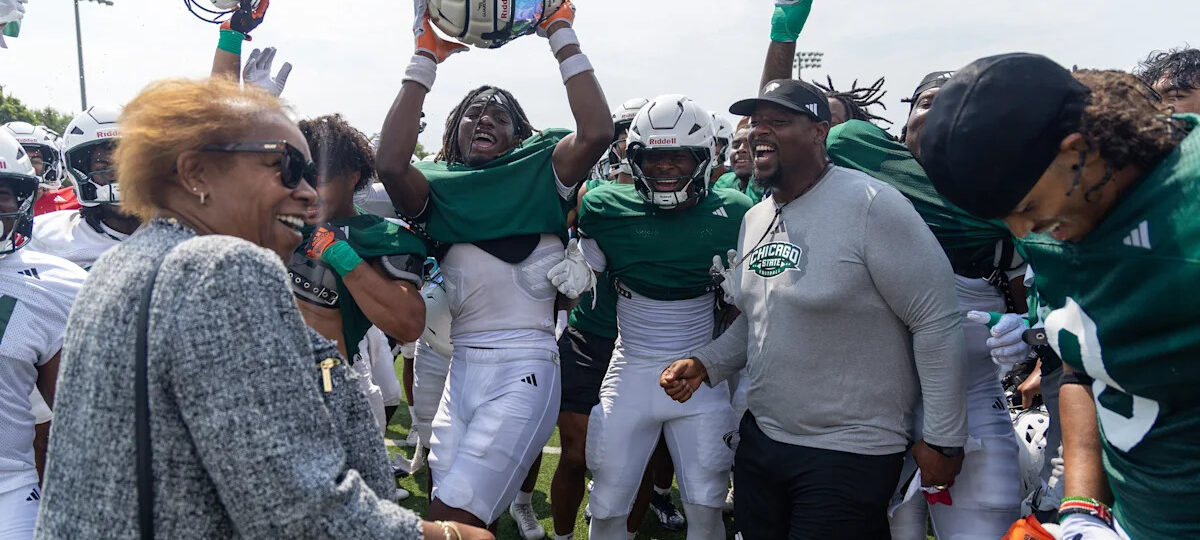
CHICAGO — Chicago State football players in green and white jerseys headed en masse toward the sideline of their turf practice field, which sits painted in the outfield of the Cougars baseball stadium.
Their destination was Chicago State President Zaldwaynaka “Z” Scott, who was watching their Wednesday morning training camp practice on the Roseland campus alongside athletic director Monique Carroll. As the players reached Scott, they broke out in celebration, jumping and dancing and chanting “Happy birthday!”
Some offered Scott fist bumps and then headed back to work toward a milestone moment in Chicago State history that is just three weeks away.
When Carroll needs a little inspiration in the Cougars’ torrid march to fielding an NCAA Division I Football Championship Subdivision program, she watches the players, who speak with pride about laying the foundation for the only DI team within Chicago.
“To see how much it means to them, as an AD, that keeps me going every day,” Carroll said. “I’m out here to get a little motivation, feed off their energy.”
It has taken a whole lot of energy — and ambition — for Chicago State to get within striking distance of its season opener against Roosevelt on Aug. 29 at SeatGeek Stadium in Bridgeview, the beginning of an 11-game slate for the program’s inaugural team.
Chicago State, a public, predominantly Black university on Chicago’s Far South Side, first announced its exploration of a football team in 2023. The university then hired coach Bobby Rome II to be the face of the program in April 2025 as the athletic department worked to fundraise the $4 million it needed in the first year of the startup program. The university board officially approved the team in December, and Rome said it has been “a whirlwind” from there as he built his staff and roster.
Caroll and Rome said putting the program together over the last year has required understanding as they’ve faced startup challenges. And it has required belief when others might doubt the viability of the venture.
“I’m so proud of this institution and the leadership of this institution and the leadership of this athletic department, because this is the time it shows,” Rome, 40, said. “When everyone said what we couldn’t do, now we’re actually out here doing it. This is the time it shows.”
Before Chicago State could even get to the on-field product, the university, which reported an enrollment of 2,469 students last fall, had to figure out the logistics that come with the influx of about 100 players.
That meant buying equipment and uniforms but also coordinating admissions, food and housing for them. That meant figuring out massive new amounts of laundry. And it meant finding space for a group that large to work, both in the classroom and on the field.
Carroll, who has a doctorate in education, said the athletic department hired consulting firms and she sought advice from other administrators and coaches from previous career stops.
“All of the things that when you’ve been playing football 50, 60, 100 years it’s just ingrained and you don’t think about it,” Carroll said. “With us being a startup program, it’s just making sure we dot all the I’s and cross the T’s because when we hit the field nobody’s going to give us a break.”
Chicago State built a new weight room to accommodate more people and will open a bigger training room later this summer. They painted the football practice field on top of the turf baseball field, which was constructed in 2014. CSU dropped its baseball program in June 2020 and added men’s soccer instead.
The current practice field setup doesn’t have field-goal posts, so the specialists go to an adjacent grass field that has them. For Carroll, those posts are a symbol of the challenges that come with building a new program.
“I don’t believe in perfection, but I definitely believe in excellence,” Carroll said. “The field-goal posts, (they say), ‘Oh, we can just keep running over there to do it.’ Is that really excellence? It has been challenging to manage my own expectations. … That’s the challenge is prioritizing. What is really for today? What can wait until tomorrow?”
Another challenge was finding the right place to play.
Carroll said administrators would have liked to play close to campus on the South Side, and they explored a number of facilities, including some Chicago high school stadiums.
But the athletic department wanted suites for its fans. It wanted a home locker room for its players so they didn’t have to go straight from the bus to the field. And it needed a big enough press box to accommodate college coaching staffs and potential TV productions.
That made SeatGeek Stadium in Bridgeview, the former home of the Chicago Fire and Stars, the right fit, even though it’s 13 miles from campus. Carroll said they have an agreement for the 2026 season, and she plans to work on 2027 when a schedule is set.
Carroll said she and Rome also worked together to build a schedule that the Cougars hope they “align well with.”
Chicago State is operating as an independent before joining the Northeast Conference in football next season. The Cougars will play Division II Roosevelt, plus NAIA Kentucky Christian and two other teams from the National Christian College Athletic Association. But the schedule also includes trips to UT Martin and Tarleton State, both ranked in the FCS preseason top 25, measuring-stick-type games that Carroll said can show alumni and donors what it takes to be great.
Amid it all, Carroll and Rome have continued fundraising for the program, a passion for Carroll as she continues building relationships with potential supporters. She said the new football team was the talk of an alumni breakfast she attended in the spring, and she is embracing the novelty of being a first-year team and the attention that brings. They needed the financial backing to get the program off the ground.
“FCS football is a revenue generator,” Carroll said. “We knew once we got started, the money was going to be there. But we wanted to make sure we didn’t overtax ourselves to fund the startup costs. Fundraising was around the startup costs.”
When Carroll and Rome met for his job interview, they spent an entire day — breakfast, lunch and dinner — going over a 186-page plan for Chicago State football. Rome asked questions so he was informed about what he was stepping into. But he had previous experience that gave him an understanding of the job.
Rome, a former quarterback and fullback who was a teammate of Chicago Bears coach Ben Johnson at North Carolina, helped build a program at Far Eastern Federal University in Russia after his playing career. He also took over as head coach at Florida Memorial when the team was in just its third season after a 62-year hiatus.
He knew that building a program comes with hiccups as many parties collaborate.
“I learned there’s always room for improvement, and you’ve got to have some grace. Everybody has to have grace for each other,” Rome said. “I have to be the one in the middle refereeing that grace and making sure that it goes both ways and it’s fair. At the same time, we have to understand when there’s got to be an expectation, when there’s got to be a standard set.”
As Rome set out to bring coaches and players to Chicago State, he wanted talent, obviously, but also people who understood what it meant to be a part of a startup.
In December, just before the transfer portal opened, Rome named Bobby Blizzard and Le’Marcus Gibson, who both coached at Hampton, his offensive and defensive coordinators. He wanted to have coordinators in place so transferring athletes knew who they would be playing for, and he eventually built his staff to include nine assistants.
Then he set out to create his roster.
“We wanted young men that did not mind coming in and pouring the foundation for a first-time football program,” Rome said. “That takes a special type of young man, and also we wanted young men that fit the profile of what we’re looking for here at Chicago State. We want good kids that can play football, that can handle business in the classroom but also understand that this right here is a stepping stone for the university.
“We are building the foundation that’s going to be standing for a long, long time. … We had a lot of young men that wanted to be a part of that.”
When wide receiver Arshawn “AJ” Powell, who was a freshman at Southern Illinois last season, talked with Rome in the winter about transferring, they talked about Powell’s goals after football and the type of man he wants to be. And they talked about the impact Powell, a former Westinghouse and Evergreen Park player, could have as a member of Chicago’s only DI football team.
Powell loves the idea that Chicago high schoolers don’t have to travel hours away to play on such a team.
“I really understood the foundation he wanted to lay,” Powell said. “It’s bigger than us. I want to build it for the kids that want to come here in a couple of years.”
Wide receiver Kaymen Coleman, a Von Steuben graduate, said his conversations with the coaching staff were also about building a culture. Coleman worked through a broken collarbone and coaching staff changes at two junior colleges and an NAIA school before returning home last season. He was working security and training when he received an opportunity at NAIA Judson in Elgin, where he had 33 catches for 239 yards.
Now, he said, it’s “a dream” to join Chicago State.
“They saw I had been through a lot of adversity and saw how I pushed through it, and they wanted that as a leader here, to help set that culture, push the other guys around me to keep going when times get hard,” Coleman said. “You’re always going to face some adversity in life, but it’s about how you push through that makes you a man.”
Coleman and Powell both got on campus this winter, two of about 40 players to arrive a semester early.
Coaches didn’t hold traditional spring practices, focusing instead on lifting and conditioning and mental preparation, including meetings to go over the new schemes. Players also did their own on-field work so they would be prepared when summer camp officially opened.
This month, Rome said the Cougars are holding competition at every position and will let that play out through camp as they near the opener. That includes six quarterbacks in competition to start and 29 first-year players on a roster of around 90 players.
Coleman believes the biggest obstacle for an entirely new team is getting the players to jell.
“The difference is just figuring out how to get that chemistry together,” Coleman said. “When you’re on a team that’s already had set starters, you can get that chemistry in the offseason. But our first time meeting was in the spring, so that’s why we were really big on building the team and setting that team foundation in the spring so when it carries over to summer we’ve got that chemistry rolling.”
Not every player sees that big of a difference in starting with a new team. Linebacker DeJuan Harris, who played the last two seasons at DII Lake Erie, said “it’s still football.” He and other players said they are trying to ignore outside doubts about the likelihood of success in Chicago State’s first season.
Success as a startup is not unheard of. Last season, the University of Texas Rio Grande Valley, located in Edinburg, Texas, went 9-3 in its inaugural season, the most wins ever for a first-year FCS or Division I-AA team. But UTRGV and its coaches had a much longer on-ramp to its first season, including a summer and fall practice season in 2024.
Though Chicago State’s circumstances are different, players are maintaining hope.
“We’ve got a lot of expectations,” Harris said. “We’re not trying to come out here and lose. A lot of people already have written us off. They already think we’re going to have a bad season. We see all the comments. We just use that for motivation.”
Carroll said she also has seen a motivated Rome, noting “this was everybody’s opportunity” at the Division I level. As she has watched his preparation, she doesn’t think he is taking the opportunity lightly and said she’s excited to see him grow in the role.
Rome said there is still a lot of work to be done in just a few weeks to get ready, but he’s glad his players are embracing high expectations.
“We allowed them to come in and set the culture, set the standard of what they wanted this thing to be,” Rome said. “They want to win right now. We want to win right now. The university deserves to win right now. The city of Chicago deserves to win right now.”
Discover more from NAIRAVOICE.COM.NG
Subscribe to get the latest posts sent to your email.