
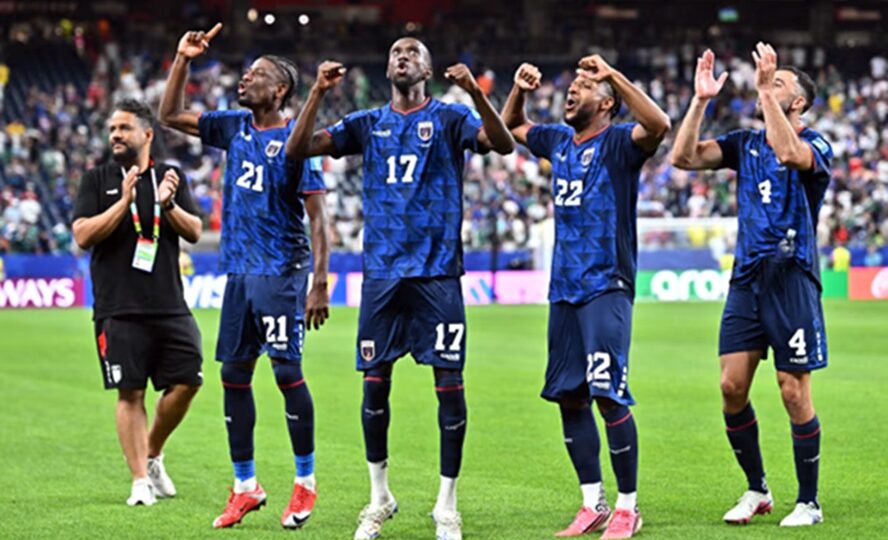
Every World Cup produces a surprise. Every so often, it produces a story that transcends football itself. In 2026, that story belonged to Cape Verde.
They did not lift the trophy. They did not reach the quarter-finals. They did not even win a match in normal time during the tournament. Yet when the history of this World Cup is written, the tiny Atlantic island nation will occupy a place far larger than their size would ever suggest.
For a country of roughly 525,000 people, making a World Cup would have been enough. Instead, Cape Verde turned their debut appearance into one of the greatest underdog stories the competition has ever seen.
From Debutants to History Makers
Cape Verde arrived at the tournament as complete outsiders.
Drawn into a group featuring Spain, Uruguay, and Saudi Arabia, few expected them to survive. Spain entered the competition as defending European champions, while Uruguay carried the pedigree of a two-time World Cup winner.
Yet from their very first match, Cape Verde announced that they were not merely there to participate.
A remarkable 0-0 draw against Spain became one of the shocks of the opening round. The match was defined by defensive resilience, tactical discipline, and an inspired performance from veteran goalkeeper Vozinha.
The result immediately transformed perceptions.
This was no longer a charming newcomer. This was a team capable of competing with the world’s elite.
They followed that performance with a thrilling 2-2 draw against Uruguay, scoring their first-ever World Cup goals and proving that their success against Spain had not been a one-off event.
A final 0-0 draw against Saudi Arabia completed an extraordinary group-stage campaign. Three matches. Three draws. Zero defeats.
Most importantly, it secured qualification for the Round of 32.
The Smallest Nation Ever to Reach the Knockouts
Statistics do not always tell the story in football.
Sometimes they tell an astonishing story.
Cape Verde became the smallest nation by population ever to reach the knockout stages of a men’s FIFA World Cup.
That achievement alone places them among the great World Cup surprises.
They finished above Uruguay and Saudi Arabia in Group H and became the first World Cup debutant to reach the knockout rounds since Slovakia in 2010.
But perhaps the most impressive aspect of their achievement was the manner in which it was accomplished.
Cape Verde did not advance through fortune or defensive desperation alone. They frustrated Spain, came from behind against Uruguay, and frequently looked the more dangerous side against Saudi Arabia.
Bubista’s Masterpiece
Every great tournament run has an architect. For Cape Verde, that figure was head coach Bubista.
Under his guidance, the Blue Sharks became one of the most tactically organised teams at the tournament. Their structure without the ball was disciplined, compact, and intelligent. Their transitions were purposeful. Their collective belief never wavered. Most importantly, Bubista convinced his players that reputation did not determine outcomes.
Against Spain, Uruguay, and Saudi Arabia, Cape Verde played with a level of courage that exceeded expectations. They never appeared overwhelmed by the stage or intimidated by the opposition.
The phrase most associated with their campaign became simple: small islands, big dreams.
Rarely has a slogan felt so accurate.
Vozinha: The Face of the Tournament
Every fairy tale needs a hero. Cape Verde had several, but none more prominent than goalkeeper Vozinha.
At 40 years old, he became one of the tournament’s defining figures. His performances against Spain, Saudi Arabia, and especially Argentina elevated him from respected veteran to World Cup icon.
Against Spain, he helped secure a historic clean sheet. Against Saudi Arabia, he again preserved a crucial point.
By the end of that match, millions around the world knew his name.
The Night Cape Verde Almost Shocked the World
The reward for finishing second in Group H was a meeting with defending world champions Argentina.
On paper, it looked like the end of the story. Instead, it became the chapter that immortalised Cape Verde’s run.
Argentina eventually prevailed 3-2 after extra time, but the result barely captures what unfolded. Cape Verde twice equalised, pushed the reigning champions to the brink, and came within moments of producing one of the greatest upsets in World Cup history.
Deroy Duarte levelled in normal time. Sidny Lopes Cabral produced a sensational extra-time equaliser that stunned the football world.
Only an unfortunate own goal eventually separated the teams. Argentina advanced.
But Cape Verde left with something arguably more valuable: universal admiration.
More Than an Underdog Story
It would be easy to reduce Cape Verde’s World Cup to a simple Cinderella narrative.
That would miss the point. This was not merely a lucky run. It was evidence of how modern football continues to evolve.
Cape Verde demonstrated that organisation, intelligence, belief, and collective identity can narrow the gap between nations with vastly different resources. They showed that World Cups remain capable of producing stories that transcend budgets, populations, and reputations.
Their success also showcased the strength of a footballing culture built through a global diaspora and a national identity that extends far beyond the islands themselves.
A Legacy Bigger Than Results
Long after the final score against Argentina fades from memory, Cape Verde’s 2026 World Cup will endure.
It will endure because they became the smallest nation ever to reach the knockout stage. It will endure because they held Spain, drew with Uruguay, and pushed Argentina to extra time. Most of all, it will endure because they reminded football of its greatest truth: that dreams remain possible.
The Blue Sharks arrived in North America as debutants. They left as one of the defining stories of the 2026 FIFA World Cup—and perhaps the tournament’s most beloved team.
Editorials
Colombia vs Ghana Bet Builder Tips – 4/1 World Cup Special, Analysis & Predictions
Editorials
England can still make a deep run at the FIFA World Cup
Editorials
July 3rd: Friday’s World Cup Accumulator – 5/1 Special, Betting Tips & Analysis
Editorials
Liverpool After Diomande Blow: Alternative Paths in a Shifting Transfer Landscape
Editorials
Belgium vs Senegal Bet Builder Tips – 3/1 World Cup Special, Analysis & Predictions
Editorials
France vs Sweden Bet Builder Tips – 4/1 World Cup Special, Analysis & Predictions
We use cookies to ensure you get the best experience on our website. By using our website you agree to our use of cookies in accordance with our Privacy Policy.
Discover more from NAIRAVOICE.COM.NG
Subscribe to get the latest posts sent to your email.