
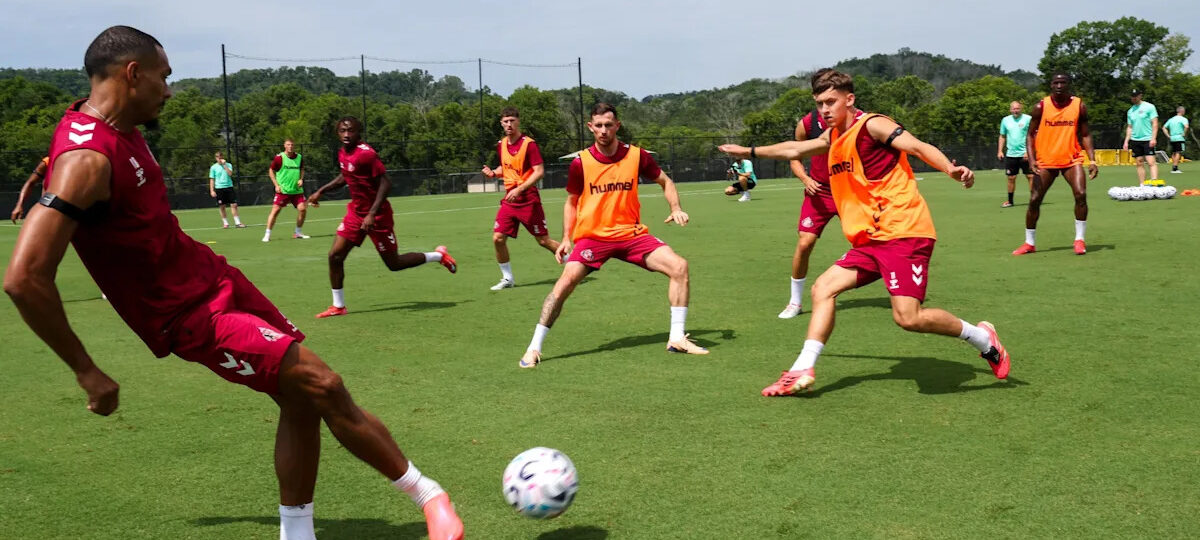
 Wilson Isidor crosses the ball during a Sunderland AFC
The 2026 World Cup has finished, and it’s a good time for reflection — especially as, coincidentally, Sunderland have arrived in the United States.
So, I ask myself: what can we glean from the tournament, and how can Sunderland influence perceptions of football while on tour in the USA? Because there’s a bigger question here.
As football becomes an increasingly global business, how much should we embrace the American way of doing things, and how much should we protect what makes our game uniquely ours?
The most obvious American influence is the approach to marketing and commercialisation, and let’s be fair: at Sunderland — now more than ever — we’re embracing the need to recognise football as a business.
If we want to be one of the big boys, we need to become more business-savvy and Tom Burwell has repeatedly made this point, astutely recognising the need to balance commercial growth with proper care for supporters.
Football needs to make money but it shouldn’t become a ‘product’ designed simply to optimise the amount that can be extracted from you and me — the customers and supporters.
At Sunderland, I feel this is especially obvious, as the Stadium of Light isn’t just a venue where forty-odd thousand people come together to consume a match day experience.
It’s our community. Our home. Our history. Ours.
The World Cup pushed ticket pricing to another level, with four-figure prices becoming the new norm. I get that there has to be plenty of room for corporate hospitality and premium experiences as clubs need commercial revenue and, when properly managed, that revenue can benefit everyone.
But there also needs to be a recognition that football was built by ordinary supporters. We saw during Covid that empty stadiums don’t work. It’s the atmosphere that makes the game. If the ordinary fan — with respect, and I’m one of them — is priced out, football may well become more profitable, but it will be all the poorer for it.
I’m not going across to Nashville for the pre-season tour. I wish I was as I’m a country boy at heart. But I do hope pricing is sympathetic to those who have travelled. Because I know, with absolute confidence, that the Sunderland lads and lasses making the trip will be tremendous advocates for our club.
And on the pricing front, I hope someone mentions that you can get a pint of American beer, with table service, for £1.99 in Sunderland. Just saying.

In my view, there’s an obvious clash of cultures between the USA and Britain. America does spectacle brilliantly, but often it comes with jazz hands, manufactured applause, audience prompts and over-the-top reactions.
Do we really need to turn every component of match day into an entertainment package driven by adverts and has-been celebrities?
The half-time show at the World Cup final was a perfect example. And I loved Wayne Rooney’s heartfelt, articulate and concise assessment: “I like a lot of them artists, but I thought it was crap.”
He said out loud, on television, what many traditional football supporters were probably thinking. The show was undoubtedly professionally produced and featured some huge names, but was it what people had come to a World Cup final to see? I’m not convinced.
Football already has entertainment — it’s called “the match”.
We have drama, tension, joy, despair, humour and theatre. We have tifos, pre-match routines, songs, and the noise of thousands of people reacting together. We don’t need to manufacture it.
Perhaps the best entertainment is the stuff football supporters create for themselves.

No hydration breaks, please — for me, they’re poorly disguised advertising opportunities.
Football is a game of two halves, not four quarters, and the traditional fifteen-minute half-time interval is part of the rhythm of the game. It used to be ten minutes before corporate hospitality took off, didn’t it?
Fifteen minutes gives players enough time to recover and managers enough time to make adjustments. It gives me enough time to get a drink, go to the loo and have some craic about the first half. That’s enough.
Perhaps an extra fifteen minutes also means that thousands of people have more time to buy more beer. What could possibly go wrong?
I don’t know what’ll happen with Sunderland’s pre-season games in the USA, but I sincerely hope there’s a reversion to the normal pattern of things.
Football is a game of two halves. Let’s keep it that way.

President Trump gave us a masterclass in exactly what not to do when hosting a World Cup.
The desire to be associated with the tournament is understandable as residents and politicians naturally want to be seen alongside successful sporting events. It’s fantastic PR and hosting a World Cup brings enormous prestige, global attention and political opportunity. But there has to be a line and in my view, it was crossed.
Football’s governing bodies must remain independent.
Presidents shouldn’t be able to influence sporting decisions, pressure governing bodies, interfere in disciplinary matters or use football as another extension of political power — nor should the World Cup become a backdrop for political grandstanding.
Once politicians begin influencing who plays, who doesn’t, who’s punished and who’s forgiven, we have a serious problem.
Football needs strong administrators. It doesn’t need presidential interference.

It’s 2026, and the behaviour of certain players and fans needs to change.
In the World Cup final, Argentina plumbed new depths, for me — the worst, and across the sporting divide, I look at rugby union and see referees being treated with a level of respect that football could learn from.
Now, I know it’s a different game and perhaps some decisions are easier to make, but rugby union seems to have found the right balance between technology and authority.
The referee is in charge. The players know it and respect it. The captains communicate with the referee. And, generally, there’s a culture that says you can disagree with a decision without behaving as though the referee has personally insulted your family.
Football needs stronger referees. The captain should be the principal point of contact. Dissent should be punished more consistently. Surrounding the referee should result in an immediate yellow card — or perhaps even a five-minute sin bin.
But mainly, we should accept that referees, like players, will occasionally get something wrong. Football doesn’t need perfect refereeing. It needs credible refereeing. And it needs players who understand that hassling the referee achieves nothing.
Which brings me to Sunderland, and I wish we would lead the way.
Take the higher ground, set the standard and let our players be the ones who walk away from the referee rather than surround them. Let our captain be the one who speaks for the team. Let our supporters be the ones who recognise that, sometimes, the referee is simply going to get it wrong.
Because if Sunderland are going to America to show people what our club is about, perhaps this is part of it. Not just what we sing and how passionately we support the Lads, but how we behave.

So, there’s lots to mull over as the World Cup gradually fades into the ether.
I don’t want to see football being “Americanised”. For me, it’s about globalising the game without losing its soul.
The American sporting model has plenty to teach us about presentation, marketing, commercial growth and reaching new audiences. We should embrace the best of that but we should also be confident enough to leave behind the things that don’t belong in our game.
We don’t need to price ordinary supporters out. We don’t need to turn every match into a television show. We don’t need longer half-times simply to create more commercial opportunities. We don’t need politicians interfering in sporting decisions and we don’t need to lose the authority of the referee in the name of entertainment.
What we do need is football that can grow without forgetting where it came from. A sport that welcomes new supporters without losing the old ones. A sport that can become global without becoming generic.
And this is where Sunderland have an opportunity.
Sunderland are about to get the chance to show parts of America what football’s soul looks like — the songs, the humour, the passion and the traditions.
If they get the balance right, Sunderland can take the best of British football to Nashville, New Jersey and Pennsylvania. They can show that commercial success and supporter loyalty don’t have to be opposing forces; that global reach doesn’t have to mean losing local identity and that you can embrace the future without forgetting your past.
And perhaps that’s the real lesson of the World Cup.
Football doesn’t need to become American to conquer America. It just needs to show the world why we fell in love with it in the first place.
And, whatever happens on the pitch, I hope the Sunderland travelling party leave America with one thing ringing in their ears.

Discover more from NAIRAVOICE.COM.NG
Subscribe to get the latest posts sent to your email.