
- Photos and satellite images show how Black Rock City rises from Nevada’s desert.
- About 70,000 burners are expected to attend this year’s festival.
- Images capture entry lines, camps, artwork, and the temporary airport.
Laying the groundwork

The Black Rock City Municipal Airport

The Black Rock City Municipal Airport, which springs up for just 13 days a year, appears to be in full swing based on satellite images.
Instead of asphalt, the airport is built from scratch each year on the dusty playa. Staffed almost entirely by volunteers, the temporary airport serves general aviation and private planes, as well as Burner Express Air, which is a designated event charter flight that carries some attendees between the temporary airport and Reno, the San Francisco Bay Area, or Southern California during the event.
Center Camp

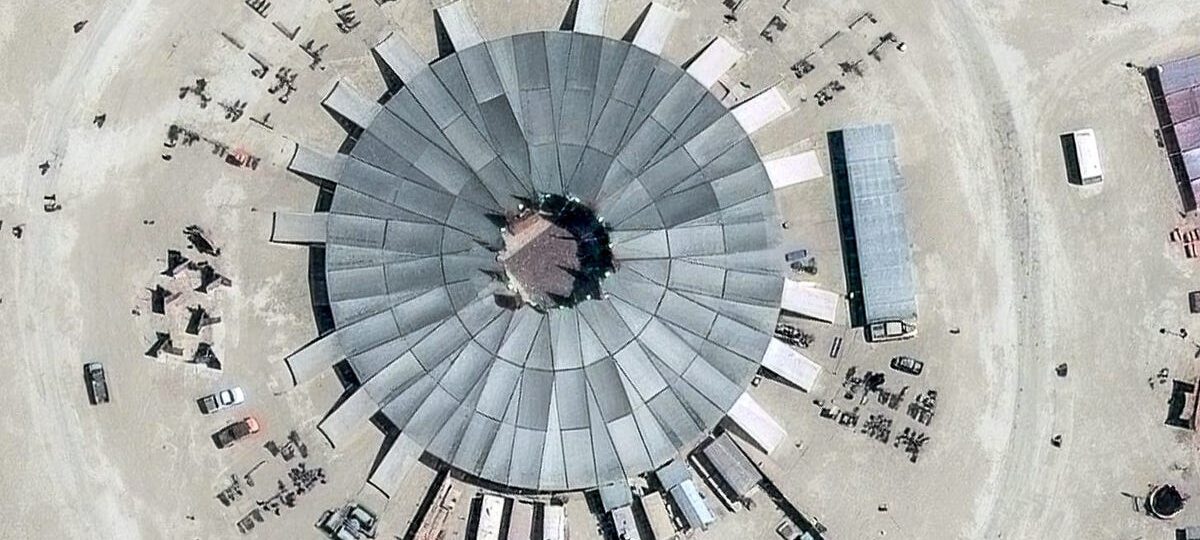
Center Camp sits near the 6 o’clock edge of Black Rock City. Its acre-wide canopy provides shade and hosts performances, art, drinks, and gatherings.
Mostly staffed by volunteers who handle scheduling, daily operations, and bartending in the ring of interactive camps that surrounds the plaza, the area is one of Black Rock City’s main civic spaces and natural meeting points.
The Cryptomeria pavilion

At Black Rock City’s geographic center, the Man is taking shape above the Cryptomeria, a tree-inspired pavilion with rootlike approaches and spiral stairways that climb nearly 60 feet. This year’s pavilion was named and designed by designer and inventor Alexander Rose, a longtime burner.
Around it, temporary installations are expected to gradually spread across the open playa, creating an outdoor gallery.
The Temple of the Moon

Art installations are taking shape across the playa.
The Temple of the Moon installation made especially for the 2026 Burning Man, as pictured, is a 170-foot-wide sanctuary inspired by the Queen of the Night cactus and lunar cycles. Its petal-like forms surround a chamber reaching 52 feet.
The installation was created by artist James Gwertzman alongside the Moonlight Collective and Temple Build Crew as a quiet space for grief and remembrance.
Sandstorms on the playa

Starting Wednesday, high winds brought dusty conditions to the playa, and participants can be seen braving the sandstorm to view art installations.
A temporary gate closure

Earlier on Thursday, visibility was already low, and participants could be seen huddling on art installations to wait out strong winds. Such sandstorms are not uncommon in the Nevada desert.
By Thursday evening, the winds caused near-whiteout conditions at Burning Man and forced officials to temporarily close the entrance gate.
‘Eiffela Broken Dream’

French artist Philippe Maindron’s “Eiffela Broken Dream,” a steel sculpture built at one-tenth scale to the actual Eiffel Tower, debuted on Thursday. Its two halves stretch roughly 100 feet across the playa, aimed at evoking themes of collapse, displacement, and resilience.
The tower, weighing 29 tons and featuring a dramatic split, was transported from France by CEVA Logistics and arrived on the playa on September 3.
Countdown for The Man

The Man structure has now fully risen above the Cryptomeria pavilion.
According to the countdown on the Burning Man website, The Man will burn on Saturday night, September 5, at around 7:30 p.m. PT. Sunday is the final day of the event.
A muddy Friday

On Friday afternoon, Burning Man organizers announced that they had to temporarily close the entrances and exits to Black Rock City and the city’s airport.
The closure is due to rain on Friday, which left roads and camping areas muddy. Participants can be seen treading through the mud in boots and shoes wrapped in plastic bags.
Organizers have posted on X asking people to “delay your travel to BRC and wait for updates.”
Discover more from NAIRAVOICE.COM.NG
Subscribe to get the latest posts sent to your email.