


 BBC
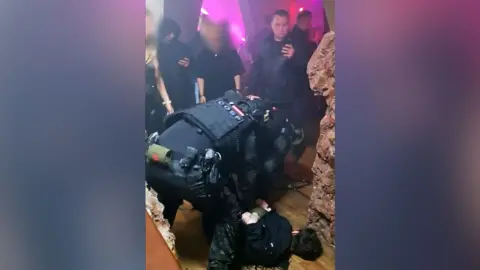
BBCKatya was about to blow out the candles on her 30th birthday cake when masked men burst into the nightclub hired for her party, and began physically and verbally attacking her friends.
“They called us faggots and lesbians. I could hear violence from every corner,” she told a BBC World Service investigation. Her mother was told to get down on all fours, she says.
The swoop was instigated by a vigilante group, called Russkaya Obshina, that wants to accelerate President Vladimir Putin’s agenda to stamp out what he describes as Western liberalism, and promote traditional family-oriented values.
As is sometimes the case in these raids, members of the police joined them. Russkaya Obshina stated in a subsequent video it shared on social media that it was looking for evidence of LGBT “propaganda”, which is illegal in Russia. Nothing of this nature was found, but Katya was nevertheless interrogated by law enforcement.
Nine months later she was convicted for blasphemy because there had been a red neon crucifix-shaped light hanging on the wall of the nightclub.
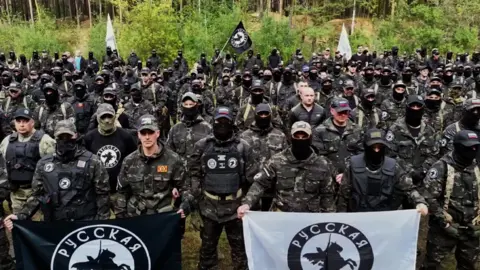
Russkaya Obshina is the biggest of a network of nationalist groups in Russia, and the number of raids it has carried out has rapidly increased in the past two years, our investigation found. We have also found evidence suggesting it has received funding from charities run by figures close to the Kremlin.
Katya, well-known in her home city of Arkhangelsk for hosting parties for an alternative crowd, says during her interrogation a law enforcement officer told her she did not conform with traditional values and there was “something wrong with her”.
She was sentenced to 200 hours of community service. One witness, a member of Russkaya Obshina, told the court “the sight of the cross being displayed at the party caused him emotional shock and deep confusion”.
Katya says she now lives in fear because coverage of her case in the local media, and on Russkaya Obshina’s social channels, has led to widespread online harassment. Nevertheless, she felt it important to share her story with the BBC.
Over the past year, the BBC World Service has spoken to half a dozen current and former members of Russkaya Obshina, as well as those, like Katya, who have been impacted by its actions.
The picture that has emerged is of a movement of highly-motivated nationalist and religious Russians dedicated to patrolling towns and cities, and raiding shops, warehouses, hostels, nightclubs and abortion clinics, looking for any activity they feel violates their traditional values and potentially breaks the law. They then lobby for the prosecution of their targets.
 Russkaya Obshina
Many of the targets are migrants – the group’s videos show Russkaya Obshina members confronting them in their places of work or at leisure, and accusing them of crimes. One in four of the group’s posts refer to migrants and frequently feature racist language, we found.
Russkaya Obshina did not reply to the BBC’s request for comment, but did address our allegations on its social media: “Even though Russkaya Obshina is an informal community of people, with no legal entity and no membership, the BBC’s great thinkers have somehow ‘found’ former and current members of the Obshina… If you grab anyone off the street and call them a member of the Obshina, you can put any nonsense you like into their mouth.”
We spoke to someone who says he left Russkaya Obshina only a couple of months ago. He is typical of many in the group – a former soldier who returned, wounded, from the Ukraine front line, in search of a role and purpose in Russian society.
The man, who we are calling Dimitry, is glad to channel his military training into what he sees as issues at home – the effect, he says, of “foreign intrusion” on the country’s culture.
“People from other cultures come in and Russkaya Obshina responds like an antibody, stopping them harming the organism. You could say Russkaya Obshina is like a kind of doctor,” he says.
Last year, the Russian Orthodox Church, a powerful ally of the Russian state, recommended all its bishops build partnerships with Russkaya Obshina – formalising ties that were already active, and further legitimising the group as it seeks to promote values in line with the church’s teaching.
Given the government’s tight regulation of public life, it is unlikely that Russkaya Obshina operates without the Kremlin’s blessing, analysts say.
The Russian government has for several years sought to position the country as more traditional and nationalist, but this stance hardened after the Kremlin’s full-scale invasion of Ukraine in February 2022. In November of that year, Putin signed a decree specifically dedicated to preserving “traditional Russian spiritual and moral values”.
Russkaya Obshina strongly supports Russia’s military operation in Ukraine. Last December, the group formed a joint military unit on the front line with members of the Espanola brigade, a regiment made up of far-right football fans that had already been sanctioned by the UK government.
Contrary to Russkaya Obshina’s claims that it is not backed by major financiers, documents seen by BBC Eye suggest there are influential figures who have funded it via a number of charitable foundations.
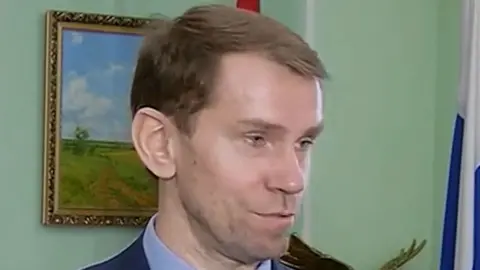
The financial documents suggest one of the two major funders is a foundation run by sugar magnate Igor Khudokormov. As a major food producer, Khudokormov is closely connected to Russian former agriculture minister – and now Deputy Prime Minister – Dmitry Patrushev, whose father is a former director of Russia’s security service and is in Putin’s inner circle, according to Russian media.
 SEIMTVKursk
Khudokormov’s agriculture conglomerate, Prodimex, is a significant trading partner with the European Union, according to US-based trade data aggregator ImportGenius.
His backing of Russkaya Obshina, with its involvement in the war in Ukraine and its anti-human rights activity, should be cause for concern for the companies trading with him, says Tom Keatinge, an expert on finance and security at the Royal United Services Institute (Rusi).
“Do you want… a Russian company providing critical materials into the food chain, especially [one run by someone]… funding the sort of activity he’s funding? That’s a question governments and companies have to answer.”
Khudokormov did not respond to our request for comment.
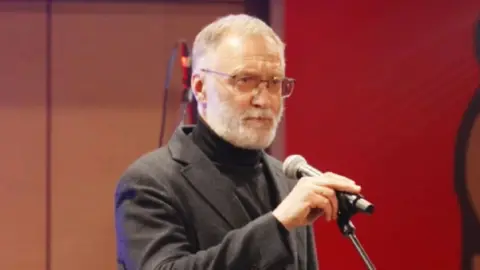
The other funder referred to in the documents is Sergei Mikheev, an outspoken media commentator reported to have worked with the Kremlin and Russian intelligence on election campaigns in former Soviet states.
 Russkaya Obshina
Mikheev told the BBC: “The charitable foundation I established, the ‘Sergei Mikheev Charity Foundation’, has never transferred any funds to Russkaya Obshina. Any documents allegedly confirming this are fake.”
To understand the scale of Russkaya Obshina’s activities, BBC Eye analysed images and videos from more than 21,000 posts from 2020-25, from the group’s main social media channels.
The posts show the first raid appears to have been carried out in May 2023, and between then and the end of 2025, suggest the group conducted more than 900 raids – 300 of which were joined by law enforcement. The numbers are likely to be an underestimate, given not all activity may be shared on public channels.
The BBC also built a multi-agent AI system – getting multiple AI programs to work together, each doing a different job and given direction by a BBC reporter – to collect and analyse social media content from multiple Russian nationalist groups, to work out which was most active on the ground.
The research, reviewed by reporters, indicated Russkaya Obshina had the most active street presence compared with more than 10 similar groups.
Russkaya Obshina has sought to position itself within Russia’s longstanding network of civilian patrols: local groups registered with the authorities and permitted to help the police maintain public order. Russkaya Obshina, however, is not registered to do this, in spite of the police’s involvement in some of its raids.
Sergei Ognerubov, who runs a registered patrol group in St Petersburg, says he has permitted Russkaya Obshina members to join his organisation, but criticises the wider movement for being unregulated and unofficial.
“If you want to taсkle migration, join us and do it legally. Simply running into some market in masks isn’t fighting migration – that’s more like petty hooliganism,” he says.
Arbitrarily targeting certain groups of people without grounds to do so could be breaking the law, says a researcher of Russia’s far right based in Moscow, Alexander Verkhovsky.
“Russkaya Obshina – which claims to uphold law and order – mainly operates through intimidation which is itself illegal” in this context, he says.
Asked for comment on our investigation, the Russian embassy in London said: “The broad public support [Russkaya Obshina] enjoys reflects the… growth of interest in national culture and historical traditions” and “it would appear that… civic engagement in Russia provokes irritation among those who seek to denigrate and discredit our country.”
For Katya, a professional events organiser, the parties have stopped – and her world and life have been disrupted following the raid, trial and community service spent mopping hospital floors.
“For 10 years, I lived in a certain rhythm. It made me happy, it was my life. What do you feel when a part of you is taken away? You feel loss.”
Additional reporting by Andrei Gorianov, Oleg Smirnov, Andreea Jitaru, Amalia Zatari, Serdar Tumgoren, Chris Zubak-Skees
Discover more from NAIRAVOICE.COM.NG
Subscribe to get the latest posts sent to your email.