
CHICAGO — Asked for his initial reaction, a front-office official for another team didn’t hesitate after watching the Chicago Bears offense in the season opener.
“That was some ‘Greatest Show on Turf’ (stuff) right there,” he responded.
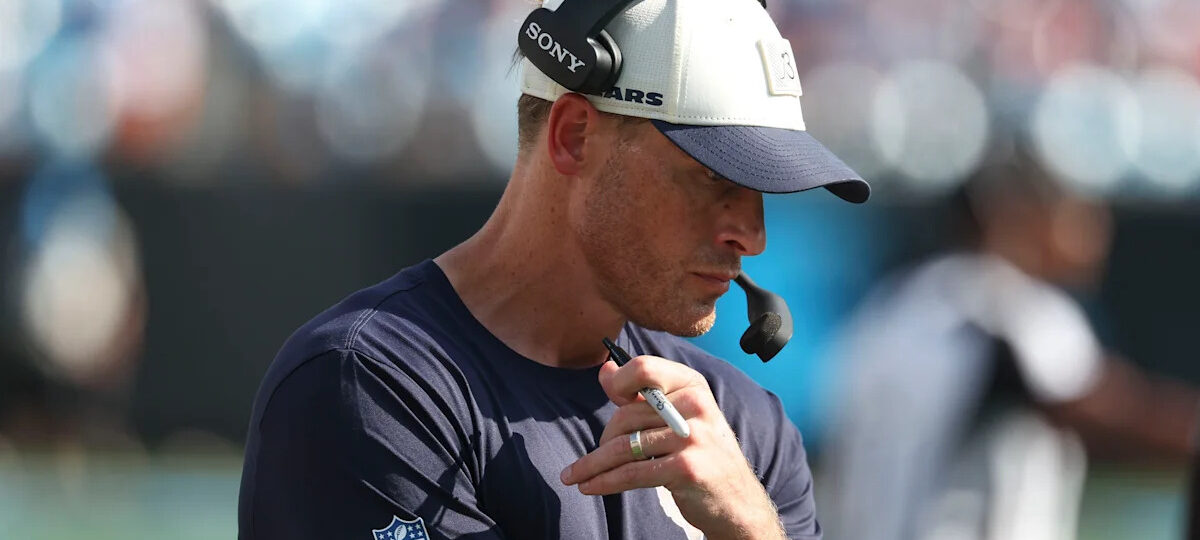
It was an off-the-cuff comparison for Ben Johnson’s offense — which scored the second-most Week 1 points in NFL history in a 59-37 victory over the Carolina Panthers — based more on how explosive the performance was than on X’s and O’s. The Bears scored eight touchdowns — six rushing and two passing — and almost nothing the Panthers tried slowed them.
The Bears offense has been one of the biggest stories around the league entering Week 2, when Johnson will be pitted against uber-aggressive Minnesota Vikings defensive coordinator Brian Flores in Sunday’s home opener at Soldier Field.
With ascending quarterback Caleb Williams looking more accurate — his 22-yard touchdown pass to well-covered tight end Cole Kmet was threaded into a small window — and more decisive as a runner, the Bears could be at the forefront of NFL offenses for the first time since the 1940s, when they moved the needle with the T-formation.
Interestingly, Johnson spent a couple of hours talking ball with Mike Martz via Zoom back in the spring. They were originally introduced when Johnson was an assistant on Adam Gase’s Miami Dolphins coaching staff.
“Mike is phenomenal,” Johnson said. “I feel like we have a shared philosophy in how we want to attack.”
Johnson has described his scheme as a “mutt,” generated with ideas from many systems, including deep passing concepts and presnap motion from “Air Coryell” and more timing-based concepts consistent with West Coast offenses. There’s a heavy emphasis on a physical running game, and he’s always seeking to attack by gaining advantages through spacing and numbers.
Martz, of course, was the Bears’ offensive coordinator in 2010, the last time they reached the NFC championship game. But he’s best-known and still revered as the innovator of the St. Louis Rams’ “Greatest Show on Turf” that revolutionized offenses beginning in 1999.
By evolving a scheme originally created by Hall of Fame coach Don Coryell at San Diego State in the 1960s, Martz turned the Rams, a team overflowing with offensive talent, into a juggernaut. They led the league in points, total yards, passing yards and rushing yards per attempt over a three-year span through 2001 that changed the way defenses had to play.
Johnson is more committed to running the ball than Martz was, but one thing often lost in the gaudy Rams statistics is that when they did run, they ran well.
Consider Johnson and Martz members of the mutual admiration society. Martz enjoys that Johnson doesn’t coach scared, a trap some NFL coaches fall into.
That goes way beyond made-for-social-media moments like ripping off his shirt postgame in the locker room. It’s how he challenges players to improve and is relentless in attacking opponents. It’s how he matter-of-factly discusses the pursuit of excellence.
“I am flattered to just be mentioned with his name, to be honest with you,” Martz said. “He’s the best one out there and I don’t think anyone comes close. And I felt that way when he was in Detroit and I said so.”
When Gase invited Martz to spend time with his staff in Miami during an offseason, he made a point of telling Martz there was a young assistant he needed to meet.
“Hey, you’ve got to go meet Ben,” Gase said. “He’s special.”
“Just go meet him,” Gase said. “You’ll figure it out.”
So Martz wandered down the hallway to Johnson’s office, where Johnson was waiting with cut-ups of the Rams offense.
“Every place I’ve ever been to, particularly in the offseason, you just kind of visit and meet with them,” Martz said. “They ask you a question and then (you) say, ‘Well, here’s what we do.’
“Ben had all these plays and all these questions for every one of them. ‘What did you tell the quarterback here?’ ‘What’s this guy doing?’ ‘What’s this protection?’ On and on and on. For me, that was coach heaven. I knew coming out of there, this guy was different.”
Martz marveled then at Johnson’s discipline and creativity. Their most recent meeting wasn’t spent workshopping the playbook but examining the big picture.
“We didn’t talk much about the Super Bowl,” Martz said. “We talked about wanting to be the best team in the history of the league. If you practice and play at that level, you’ve got a chance. Can it happen? Who knows. One team did, Miami (in 1972). It’s attainable, and if you do those things, you’re going to win a Super Bowl too.
“The performance level is everything with his players and teaching them all the tiny details of how to get better and not just what to do but why we’re doing it, so when things go wrong on the field, they know how to adjust without being told.”
Martz’s offense was a counter to a prevalent defensive tactic at the time, the zone blitz, something Buddy Ryan used a lot and Dom Capers mastered in the early 1990s.
The zone blitz paralyzed offenses, forcing them to leave in running backs and tight ends to block. It dramatically shrank the options for play callers. Martz responded by emptying the backfield — he would line up running back Marshall Faulk out of the backfield with three or even four wide receivers — and say, “Go ahead, blitz.”
“The main philosophy we talked about is we tried to dictate to the defense how the game was being played, not the other way around,” Martz said. “For so many years with those zone dogs and blitzes like Kansas City does, they get up there and intimidate you and you can only do so much. There’s a way around that. You just have to figure it out.
“So by moving and shifting, it wasn’t just window dressing. We were trying to get run force late. Get the linebackers talking to each other on the snap so they were late in their run fits. Take away all the set and personnel recognitions, which is where defense starts. They look at the sets and say, ‘OK, they can run these plays. Here’s where the ball can go.’
“If you destroy that and do a running play out of 12 different sets, what does the defense do? That’s the kind of thing we talked about.”
Martz doesn’t get a lot of credit for what he did with the Bears in two years, but six-time Pro Bowl center Olin Kreutz called Martz and Sean Payton the two best offensive minds he played for. Martz has long been viewed as the boogeyman for the trade of Greg Olsen before training camp in 2011. But tight ends had a role in his offense — the Bears immediately signed Brandon Manumaleuna in free agency — and maybe it wasn’t Martz pushing a trade that quickly turned into a bad move.
“Everyone blamed him for the Olsen trade and, yeah, he wasn’t big on Olsen,” Kreutz said. “But it was Lovie (Smith) who called me in and said, ‘I cannot watch Greg avoid blocks anymore.’ And they traded him. So it was really Lovie who traded Greg. It was nothing to do with Martz.”
Olsen might not have been a great blocker, but he was a good one for being a prolific receiving tight end and the Bears hadn’t drafted him in the first round in 2007 for his blocking prowess. Olsen got better in all areas once he got to the Panthers, who made him a major cog in their offense.
“We would get into formations and run plays and there would just be no defenders there,” Kreutz said. “Martz would shift and motion and he could call his playbook. I thought Martz was excellent. It was (quarterback Jay) Cutler that was cutting his legs out.
“Jay didn’t want to grow at that time in the offense. I remember being in a meeting and Martz telling Jay that Kurt Warner wanted to meet with him, and Jay said, ‘I don’t know what I could learn from him.’ So I said, ‘Jay, he’s a Hall of Fame quarterback.’ Anybody would want to meet a Hall of Famer at their position. He stormed out of the room.
“We went to the NFC championship game. That’s how good we got in a hurry.”
Johnson has better offensive personnel than the Bears did when they employed Martz. The starting offensive tackles in that NFC title game loss to the Green Bay Packers were Frank Omiyale and J’Marcus Webb. Luther Burden III, Rome Odunze and Kalif Raymond are an upgrade at wide receiver over Johnny Knox, Earl Bennett and Devin Hester. Matt Forte was terrific in the backfield, but Johnson has a well-rounded one-two punch in D’Andre Swift and Kyle Monangai.
The reality is the Bears didn’t have quite enough to be an offensive powerhouse when Martz was on the job. His standing as a cutting-edge offensive mind is secure. Many of the core tenets he based his system on remain prevalent in NFL games each week.
Martz, 75, is looking forward to the next Bears game to see what Johnson has in store.
“I can’t wait to turn it on,” he said. “I’ve been around some great coordinators. Nobody does it better, including me.”
Discover more from NAIRAVOICE.COM.NG
Subscribe to get the latest posts sent to your email.