Mohammed Ben Sulayem went to Kigali on Tuesday to help announce Formula 1’s first African race since 1993, and he used the occasion to put a year on the V8: 2030. The FIA president said the new engine would make the cars about 80 kg lighter and cut research and development spending by at least 50 percent, and that he was “positive” it would make its debut at the Rwandan race, according to Taarifa Rwanda, which covered the event.
None of that appears in Formula 1’s own announcement. The release F1 published the same morning confirms a 10-year deal for an African Grand Prix at a purpose-built circuit in Bugesera, about 40 km south of Kigali next to the new international airport. Racing starts once the track is finished, which F1 puts “early in the next decade.” Ben Sulayem’s contribution to the release is a line calling the deal a historic moment for the sport. There is no first-race year and no mention of engines.
Taarifa, for its part, described the V8 timing as an ambition rather than a confirmed regulation.
Ben Sulayem has given a version of this answer before, and the year keeps moving. Speaking to reporters at the British Grand Prix in July 2025, he said a naturally aspirated V8 on sustainable fuel could arrive “by 2029” at the earliest. At the Miami Grand Prix this May he told Reuters the switch would come in 2030 if the engine manufacturers agreed, and in 2031 if they didn’t. Taarifa’s account of Kigali has 2030 with no fallback attached.

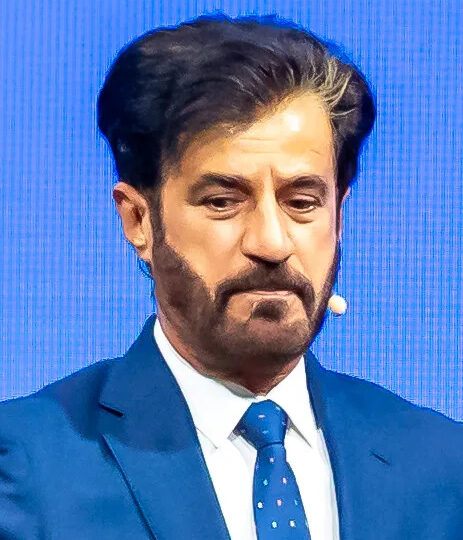
FIA president Mohammed Ben Sulayem at the Geneva International Motor Show in February 2024. Photo: Matti Blume, via Wikimedia Commons, CC BY-SA 4.0
The condition matters because of how the current engine rules were locked in. When the FIA confirmed its power unit registrations in February 2023, it signed manufacturers up for the 2026 through 2030 seasons. GM Performance Power Units was approved as a supplier in April 2025, starting in 2029, so General Motors gets a say in an engine it has not yet raced.
By Ben Sulayem’s own account in Miami, a 2030 switch needs four of the six manufacturers, GM included, to vote for it. From 2031 the FIA can write the engine rules without them. In Kigali he said he has the support of FOM and the manufacturers. No vote has been published, and no manufacturer has put its backing for a 2030 start in writing. The most specific manufacturer comment on record is still Audi’s Mattia Binotto at the Baku press conference last month, who called 2030 “the earliest introduction” and said the details were still open, as we reported at the time.
The FIA’s last formal word on the subject came after the World Motor Sport Council met in Macau on June 23. There, Ben Sulayem said discussions about “future power unit concepts, including V8 engines powered by sustainable fuels” showed that all parties were willing to shape the sport’s next chapter. The communiqué contains no displacement, no power figure, no electrical share and no start date.
At the same meeting, the council ratified changes to rebalance the current V6 hybrid’s combustion and electrical output across 2027 and 2028. The FIA is still rewriting the rules for an engine its president wants retired after four seasons, and that engine has had a rough first year on track: George Russell’s Bahrain engine failure ended in a grid penalty in Singapore.
The 2026 rules set the minimum weight at 768 kg, including an estimated 46 kg of tyres, which was 30 kg less than the previous generation. Another 80 kg would take roughly a tenth off the car, more than two and a half times the 2026 cut. Ben Sulayem did not say whether the saving is the engine alone or the whole car. The electrical system is the obvious candidate: today’s cars deploy up to 350 kW from the battery, and in May he said the V8 would carry “very, very minor electrification.”
The 50 percent figure has no published baseline. At Silverstone in 2025 Ben Sulayem said power unit R&D was approaching $200 million, and he set the same “more than 50 percent” savings target then. The FIA’s financial regulations for engine makers cap their spending each year, but nothing the FIA has issued says what a V8 programme would be allowed to cost.
The FIA ends its year in Shanghai, with the FIA Awards set for December 12. The World Motor Sport Council meets there on December 10, as we laid out in September, and that is the next meeting where a V8 framework with numbers attached could be approved. If one doesn’t come out of it, the manufacturers would have about three years to design, build and test a V8 with no published rules.
Should the FIA push the V8 into 2030 on a manufacturer vote, or wait until 2031, when it can write the rules alone?
Sources: Formula 1 announcement of the African Grand Prix (October 13, 2026); Taarifa Rwanda coverage of the Kigali launch; FIA World Motor Sport Council communiqué (June 23, 2026); FIA 2026 power unit supplier registrations (February 3, 2023); FIA approval of GM Performance Power Units (April 23, 2025); FIA 2026 Formula 1 regulations presentation (June 6, 2024); FIA Awards announcement; Reuters reports of Mohammed Ben Sulayem’s remarks at Silverstone (July 2025) and Miami (May 2026).
Sign up for the Backfire Newsletter. For the latest news, follow us on Facebook and Instagram.
Discover more from NAIRAVOICE.COM.NG
Subscribe to get the latest posts sent to your email.