
Lucid Motors made a round of cuts that show how the EV maker is tightening its belt as it pursues an ambitious future in the midsize car market and robotaxis.
Lucid said on Monday that it would cut about 18% of its US workforce, including eliminating the chief operating officer role held by Marc Winterhoff.
Winterhoff also served as interim CEO for less than two years before Silvio Napoli was tapped for the role in April.
In a securities filing, Lucid said it made the move to advance the company’s path toward profitability and positive cash flow.
The cuts come at a pivotal time for the company.
Lucid has yet to prove that it can profitably scale its EV business.
At an investor day in March, it laid out a sprawling future to diversify its vehicle lineup with sub-$50,000 midsize SUVs and to lay a stake in autonomous driving and robotaxis.
Winterhoff told Business Insider in April that the company’s robotaxi bet was deliberately designed to keep spending in check and avoid the kind of capital burn that would be required if Lucid had built a robotaxi operation from the ground up. “Our strategy is to offer solutions to individual customers and our robotaxi customers fast and, from our side, minimal deployment of capital investment in order to not hamper our way to profitability,” he said, adding that robotaxi was a “second leg” for Lucid to stand on next to personally-owned vehicles.
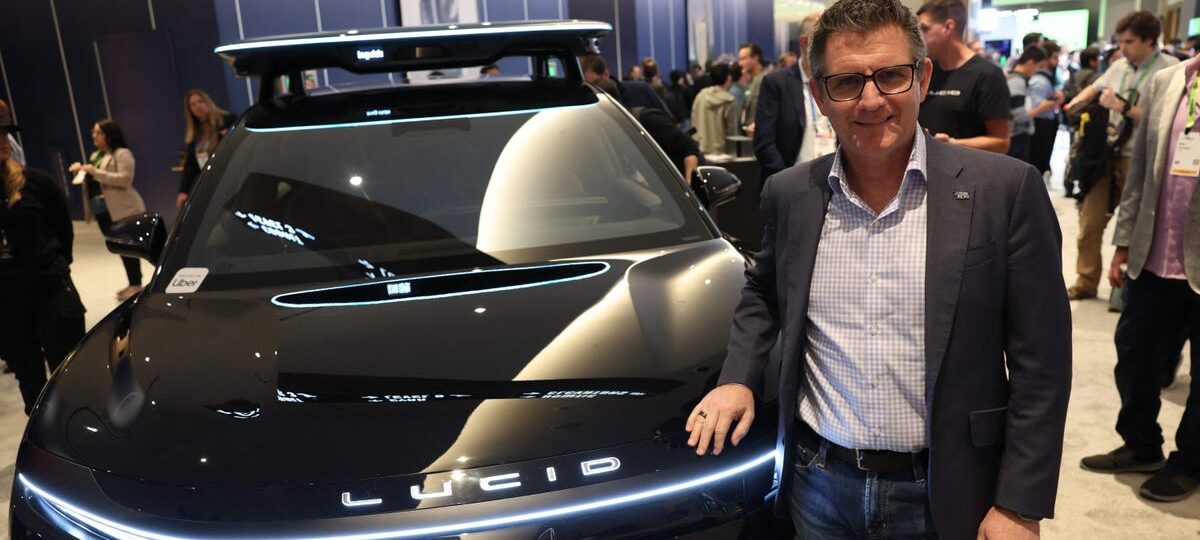
Lucid is pursuing robotaxis through a partnership with Uber and Nuro, targeting a commercial launch in San Francisco later this year.
Uber is committing $500 million to supply at least 35,000 vehicles from Lucid, including 10,000 Gravity SUVs, Winterhoff said.
Winterhoff cited speed to market and capital-spending discipline as reasons Lucid chose the partnership route.
The COO at the time said Uber wanted a robotaxi that could be ready for commercial deployment by 2026. “There was literally nobody out there saying, ‘Okay, we can do that,'” he said.
Building the autonomous vehicle stack in-house would also require “billions of investment,” Winterhoff said, for returns that may not be seen until 2030 or beyond.
Lucid expects to save some cash through its recently announced restructuring plans.
The company said in the filing that it expects to generate about $158 million in annualized cost savings.
As part of the cuts, Lucid also said it’s eliminating the second production shift at AMP-1, Lucid’s manufacturing plant in Casa Grande, Arizona.
The company did not specify which vehicle programs or production lines would be affected.
James Picariello, a senior analyst at BNP Paribas Equity Research, wrote in a note on Monday that Lucid remains on a “step road to breakeven.” The analyst wrote that the cost-cutting effort suggests demand for the Lucid Air sedan and Gravity SUV remains soft, and the $158 million in cost savings does little to change the company’s cash-burn trajectory.
Still, Picariello told Business Insider that he does not see the latest cuts as a direct threat to Lucid’s robotaxi plans. “I don’t see any real direct implication from LCID’s cost-cutting effort announced today, and its ‘contract manufacturer’ partnership with Uber/Nuro,” Picariello wrote. “LCID should still be able to provide the Nuro-outfitted Gravity’s & midsize CUVs as robotaxis to Uber.” A spokesperson for Lucid said that Monday’s announcement will not affect the company’s robotaxi strategy or its Uber-Nuro partnership.
Winterhoff did not respond to a request for comment.
Discover more from NAIRAVOICE.COM.NG
Subscribe to get the latest posts sent to your email.