LOS ANGELES — The sun shines almost every day in America’s largest college football city, but there never seems to be enough for both of its power conference programs at the same time. In the recent history of the USC-UCLA rivalry, there is almost always a gray cloud hovering somewhere.
Against significant odds given what’s happened the last two seasons, UCLA has managed to blow it out of Westwood. It’s largely thanks to new coach Bob Chesney, the relentlessly positive and perfectly coiffed 49-year-old who won at a bunch of small schools in the Northeast you’ve never heard of before taking James Madison to the College Football Playoff last season. Before even coaching a game, he has managed to convince UCLA’s administration, its boosters and most importantly its players that he can do the exact same thing on the West Coast.
“When you do your research on him, you see that he’s a winner,” said senior linebacker Jalen Woods, who has played for the same number of head coaches (three) as UCLA won games last season. “It’s not his first rodeo.”
It’s not quite the same vibe across town, where the patina of endless possibility has eroded over the last 4 1/2 years into a new and urgent reality for Lincoln Riley.
When Southern Cal pulled off a middle-of-the-night shocker to lure him out of Oklahoma at the end of the 2021 season, administrators believed — and with good reason — that they had imported a national championship-level coach who would quickly usher in a long era of dominance on the West Coast.
“It’s a paradigm shifter,” one USC stakeholder believed at the time.
But as the 2026 season begins, a visit to USC feels like a different kind of paradigm shift — into a world where every interaction is bubble wrapped because fragility has turned out to be the defining characteristic of the Riley regime.
A full 11 days before the Trojans’ Week Zero opener against San Jose State, requests to discuss the importance of this season with Riley and his interesting new defensive coordinator — former TCU coach and College Football Hall of Famer Gary Patterson — were denied.
Instead, USC’s communications staffers shepherd a group of reporters from outside the sparkling new Bloom Performance Center onto the practice field. From there, everything is carefully managed from exactly where the media is allowed to stand to watch a little bit of stretching to what photographers and videographers are allowed to shoot. After a few minutes, the pack is led to the other side of the field and then quickly to the exit.

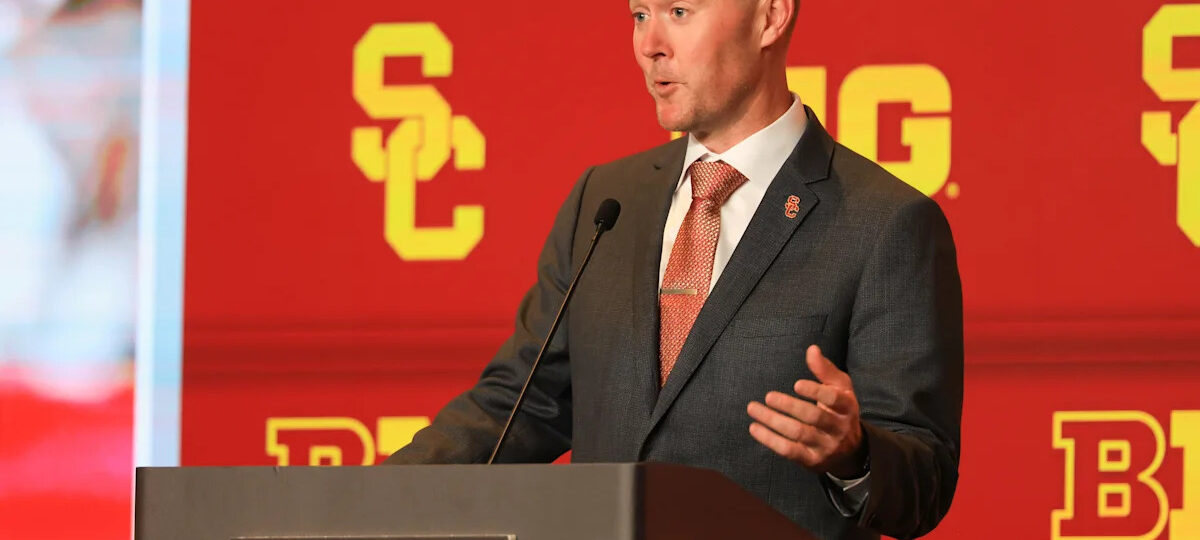
CHICAGO, ILLINOIS – JULY 28: Head coach Lincoln Riley of the USC Trojans speaks to the media during the 2026 Big Ten Football Media Days at Hilton Chicago on July 28, 2026 in Chicago, Illinois. (Photo by Justin Casterline/Getty Images)
It feels purposefully distant and vaguely like a media humiliation ritual, which is an interesting strategy for a program that has so badly lost the narrative during Riley’s tenure. After bringing SEC-level paranoia and SEC-level salaries to the West Coast without SEC-level quality of play, the angst is easy to understand.
Though it’s unclear what combination of wins and losses might cost Riley his job, four years without a College Football Playoff appearance was not the expectation or the plan. A fifth might justify spending the estimated tens of millions — because USC is a private school, few people know the true value of his contract — it would cost to fire him.
“I got a great vantage point in my years at Oklahoma of what great alignment, what steady leadership really looks like in a program,” Riley said at Big Ten media days. “I can sit here today and say really for the first time at USC I feel all of those things are operating at a high level and are very, very steady right now.”
It was Riley’s way of acknowledging that the time for excuses is over. If he doesn’t do something big this season, the cloud that has been parked over Westwood for the last few years will be moving south.
With so much tension around the city’s traditional power and so much optimism at its chronic underachiever, Los Angeles in many ways is the epicenter for how much perceptions in the coaching business have changed over the last five years.
At the time, the wild 2021 coaching cycle was defined by USC and LSU making power moves to poach Riley and Brian Kelly from elite programs where they had made the CFP multiple times. Backed by some of the biggest brands in college football, they seemed like can’t-miss hires.
By comparison, there was very little fanfare over Texas Tech hiring Baylor assistant Joey McGuire and Washington getting Kalen DeBoer, whose résumé included just one year of power conference experience.
Fast-forward to the start of the 2026 season: Kelly is working in TV and Riley is facing a put-up-or-shut-up season while McGuire is trying to lead Texas Tech to consecutive playoff appearances and DeBoer is making $12.5 million as Nick Saban’s Alabama successor.
Five years ago, it would have seemed absurd — and maybe even a little embarrassing — for UCLA to counter the splashy Riley hire with a guy who has spent most of his career at places like Salve Regina, Assumption and Holy Cross. But in a world where Curt Cignetti went from IUP and Elon to winning a national championship at Indiana within a decade, the window of opportunity for coaches with non-traditional backgrounds to hit the big time is now wide open.
“The pattern is the proof,” Chesney told Yahoo Sports. “This is not the first time I’ve been to a place hadn’t had much recent success, that maybe lost its passion and vision. I think it just takes some energy and a revival to make sure we understand that it can happen here. Let’s stop putting ourselves in a position where we’re constantly self-limiting. There’s no reason to do that. Anybody has a shot these days.”
The Chesney-Cignetti comparison is an obvious one. They both spent years piling up great records at small schools — Chesney is 132-52 as a head coach — and both had James Madison as their in-between stop before landing a power conference job that has not been perceived very well by the coaching industry over the years.
But that’s about where the comparisons end.
“They’re like opposites of each other,” said tight end Josh Phifer, who was recruited to James Madison by Cignetti, stayed there to play under Chesney and has now followed him to UCLA. “A lot of the guys that stayed [at James Madison], they were like, ‘I actually love playing football again.’ Because as brilliant as the Cignetti coaching staff was, there were times it felt like it was more scary to mess up than you felt confident to succeed. With Chesney, they only want to make you confident and not put any negative thoughts in your mind. That’s not to say we don’t correct our mistakes but they’ll never embarrass us on film, never make us feel like we’re bad football players.
“It’s fascinating. Both coaching styles work but both of them found success in different ways.”

Westwood, CA – August 06:Head coach Bob Chesney works with players Wayne Knight (3) and LaRue Zamorano III (14) at UCLA practice on Thursday, August 6, 2026. (Photo by David Crane/MediaNews Group/Los Angeles Daily News via Getty Images)
There is no topic people in college sports enjoy talking about more than coaching searches, where candidates get put in certain boxes because of their particular traits and we all try to match them with exactly the right school. But the longer you’re around this industry, you realize that nobody really knows what they’re talking about.
The reason is simple: A coach’s success in a particular job is only partly due to their own ability. A college football program is a complex organization that relies on dozens of people that most fans and media members don’t know, both internally and externally, to do much of the work that determines whether a program is winning or losing on the finest of margins. When you factor in other wild cards like the youth of the players and how college football can fundamentally change over the course of a few years, you’re essentially trying to hit a moving target from a roller coaster.
When USC hired Riley, it seemed like a sure thing because of what he had done at Oklahoma: A 55-10 record, two Heisman Trophy winners, three CFP appearances and four Big 12 titles all before the age of 40 at a high-pressure program with a huge fan base.
But in retrospect, USC was a place with unique challenges, completely different public-facing responsibilities in a pro-dominated market and fewer institutional safeguards compared to a place like Oklahoma where the leadership was stable. At Oklahoma, Riley took over a program where he did not need to be an agent of change. At USC, it became his primary duty — down to micromanaging how his program gets covered by the media.
From that vantage point, Oklahoma and USC look like completely different jobs.
There’s little doubt that Riley is a good coach. But he’s also a coach who did not face a lot of adversity or criticism until he got to USC.
Now he’s got an athletic director who didn’t hire him (Jen Cohen, who hired DeBoer before she left Washington), has not fostered much goodwill with the local media by putting the program and himself in a cocoon and has relied on a revolving door of defensive coordinators to fix an area that has been his traditional weak spot. More important than all of that, he’s lost 18 games in four seasons.
“I think we have depth and talent unlike any of my first four years at USC,” Riley said at Big Ten media days.
Maybe this will be the year it all comes together. But it needs to.
Before Riley went from coaching wunderkind to the hot seat, UCLA had to learn the same lesson that there are no sure things.
When Chip Kelly chose UCLA over Florida in his return to college football after the 2017 season, it felt like a real triumph. He had the name, the track record, the groundbreaking offense, the NFL experience — and it all amounted to was a few minor bowl appearances across his six seasons.
Kelly bolted before UCLA had the chance to fire him and athletic director Martin Jarmond responded by falling into one of the oldest and dumbest traps in college sports: Hiring a beloved program figure because he cares about the school so dang much.
As it turned out, DeShaun Foster was completely unprepared to be a college head coach. Jarmond had to fire him three games into his second season after a blowout loss to New Mexico at the Rose Bowl.
In the traditional way people think about coaching searches, it wouldn’t have been obvious to import someone like Chesney, who has never worked on the West Coast or at a power conference program.
But while UCLA may have little in common with a Holy Cross or Assumption on the surface, the skills that are fundamental to turning around those particular situations could very well turn out to be similar — starting simply with a change in attitude.
“People ask about the differences between this year and last year and I feel like they always expect an answer like, ‘Oh, we’re throwing the football better, we’re running it better,'” Phifer said. “But it’s more than that. People are genuinely staying after practice. They want to hang with each other in the locker room. It feels like people here are loving playing football a little more. You can see a lot of happiness within the facility. People should be excited to go play football.”
Or, as JMU-to-UCLA receiver Landon Ellis put it: “He’s the definition of a players’ coach. He will ask, ‘What do we need to fix?’ And the smallest thing in the building that needs fixing, he’ll go get it done immediately. He doesn’t power trip like a lot of coaches do. If you hear him talk about his story, growing up with his father and family being coaches, it was always fun. And then he got into college coaching and there was a demeaning aspect to it. That wasn’t him and it’ll never be him.”
If there’s a secret sauce to the Chesney magic that has traveled very well up to this point, it’s that culture piece where he wants the players to know the name of the janitor in their facility, where he turns everything into a score-keeping competition (with good-natured trash talk included) and where he has the team singing the school’s fight song every day before practice, making sure the players are putting enough oomph into it before they go out on the field.
“I remember standing back there as a safety in college and looking around and being like, ‘I don’t think these guys really love this game right now,'” said Chesney, who developed these rituals over years of trial-and-error. “How do we get some juice into this thing?”
These little hallmarks of a Chesney program may sound corny to people looking at analytics spreadsheets and playbooks, but they’re part of the great mystery of college football: What, besides pure talent, makes a team of 18-to-22-year-olds win? If there was an easily quantifiable answer, schools wouldn’t be firing coaches all the time.
“It’s a silly thing to sing the fight song every day,” Phifer said. “But at JMU, I knew if we were going to win the game or not by the way we sung the fight song. It builds confidence.”
In the 2010s and early 2020s, it felt like most of the up-and-coming coaches were trying to do an impression of either Nick Saban or Urban Meyer. You’re seeing that trend fade in some of the more prominent coaches over the last few years, and particularly among those with more bespoke résumés.
These are unique times in college athletics, and in a way, the NIL aspect has freed them to build rosters that more closely reflect who they want their teams to be. That, more than anything, is why a program like UCLA is only one hire away from prominence. It just may not be the hire everyone saw coming.
“What’s really cool about him is he’s been a head coach for [16] years now, so where a lot of coaches are getting their first job at this level, he already has his own identity,” defensive coordinator Colin Hitschler said. “He’s not trying to emulate somebody because he’s risen as a head coach. He knows what works within a locker room and his culture speaks.”
Chesney wants to turn it into a megaphone. He knows that throughout most of its history, UCLA has had to fight against being perceived as a basketball school or having far fewer trophies than USC.
But he has no interest in playing the underdog or having his team viewed as the “gutty little Bruins.”
“My vision for UCLA when I first got here felt bigger than UCLA’s vision for itself in some ways,” he said. “But not anymore. We’ve awoken the masses.”
And as UCLA and USC start 2026 on opposite ends of college football’s anticipation/anxiety cycle, he’s maybe even shifted the direction of the clouds.
Discover more from NAIRAVOICE.COM.NG
Subscribe to get the latest posts sent to your email.