
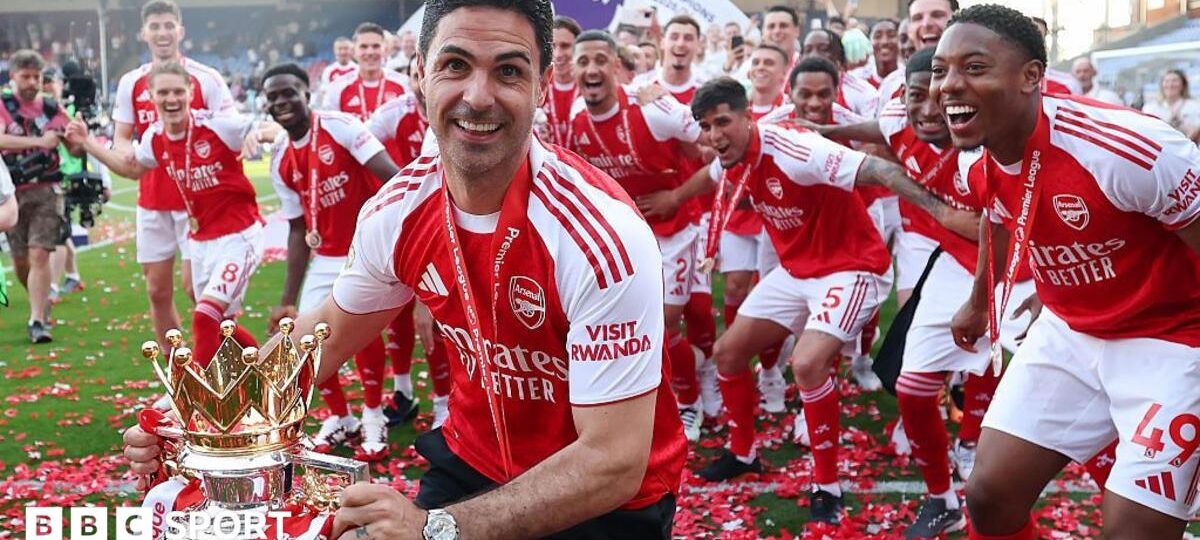
Going into the summer transfer window as Premier League champions, hope sprang eternal for Arsenal.
An opportunity to capitalise, encouraged by a sense at Emirates Stadium that their competitors were in transition because of managerial instability.
If ever there was a moment to strike in recruitment, this was it.
The plans were ambitious: a shortlist with more than 20 players on it. They were targets at Real Madrid and Atletico Madrid, even at Chelsea and Tottenham.
But as the window shut on Tuesday night, you could not escape the sense of unfulfillment – certainly from a section of supporters.
Arsenal‘s close season was one characterised by some unquestionable successes, but also riddled by difficulties and frustration.
Ahead of their home match against Chelsea on Sunday, BBC Sport details Arsenal‘s transfer window and whether manager Mikel Arteta, sporting director Andrea Berta and, perhaps most pertinently, owners Kroenke Sports Entertainment can deem their summer operation a success.
Bruno Guimaraes’s £75m capture from Newcastle United was Arsenal‘s most eye-catching signing.
Heading into the summer, Arsenal were keeping abreast of Guimaraes’ situation at Newcastle, although others were considered a higher priority.
For instance, their interest in Elliot Anderson was widely reported, but it was clear the England international was joining Manchester City.
Guimaraes’ former Newcastle team-mate Sandro Tonali and Bournemouth‘s Alex Scott were also among the midfielders explored before a move for the South American accelerated.
At the ages of 26 and 23 respectively, Tonali and Scott are younger than Guimaraes, who turns 29 in November.
But numerous factors, including availability and price – Tonali joined Spurs for a minimum £92m – made their signings difficult.
Aston Villa‘s Amadou Onana was also among the options considered, but the Belgium international suffered a serious knee injury at the World Cup.
By mid-June Guimaraes, who had universal backing inside the Emirates, emerged as the club’s primary focus.
Berta knew the player’s camp well and Guimaraes was admired by Arteta, who had made it clear he wanted proven talent to take his starting XI – rather than the wider squad – to greater heights.
Berta used his strong relationship with Guimaraes’ representatives to facilitate Arsenal‘s move, hence why Newcastle maintained they had had no direct contact from the London club until days before his move was completed.
It is not uncommon for Berta to lean on intermediaries to conduct negotiations, although the approach has had varying degrees of success.
For instance, Arsenal actively sought moves for Leicester City teenagers Jeremy Monga and Louis Page over the summer.
But sources insist that the lack of club-to-club discussions meant both players ultimately did not join Arsenal, with Monga eventually signing for Manchester City when he appeared to be on the verge of moving to the Emirates.
That said, Berta’s success in pivoting the club towards a deal for Guimaraes when it became clear other targets were not viable was well received behind the scenes at Arsenal.
The signing of Ezri Konsa was equally complex. Konsa was viewed internally as Arteta’s first-choice defensive option.
Arteta wanted players used to the rigours of Premier League football – hence the moves for Guimaraes, Konsa and the failed efforts to land Morgan Rogers from Aston Villa.
Konsa’s ability to play at right-back was also viewed as a major benefit. Arsenal considered signing an orthodox right-back, with Ivan Fresneda among the options, but Konsa’s versatility was a key factor.
But Berta appeared reluctant to meet Villa’s valuation. A week before the Konsa deal was confirmed, Arsenal made a £40m offer, which was duly rejected.
Sources claim the deal was eventually sealed by the ownership at both clubs, and the transfer was agreed at £51m, with £4m in add-ons.
In the event of not reaching an agreement for Konsa, it is understood Tottenham duo Cristian Romero and Micky van der Ven were identified as targets – but Arsenal‘s north London rivals would not consider selling to them.
Como centre-back Jacobo Ramon is a player the club will continue to monitor, but clauses attached to his current contract make the deal difficult.
Tarik Muharemovic, who joined Leeds United, was another considered.
In attack, Christos Tzolis’ impact since arriving from Club Brugge in a deal worth about £35m means the Greece international has been heralded as one of the discoveries of the summer.
It is understood the potential deal for the former Norwich winger was initially raised by an intermediary close to a senior member of the coaching staff during the close season.
Berta’s number two, Maurizio Micheli, watched Tzolis play for his country against Sweden in June and was suitably impressed.
So far, the 24-year-old looks a positive addition to Arteta’s squad.
Arsenal, who also made Piero Hincapie’s loan deal permanent and signed Illan Meslier on a free transfer, are happy with the signings they have made.
The captures of Guimaraes and Konsa, who will both be 30 by the end of next season, have raised eyebrows given the combined £126m fee, amid concerns over how the pair’s longevity may impact the natural evolution of the squad.
Yet it is undeniable that Guimares and Konsa add elite quality and experience to Arsenal ranks, and ultimately the club feel they paid the going rate to get those deals over the line.
 Image source, Getty Images
Vinicius Jr signed a new six-year deal at Real Madrid in August
While the club delivered proven talent for Arteta in defence and midfield, Berta’s remit of adding an elite attacker ended in disappointment.
Rogers was the club’s primary target heading into the window, and the early indications were positive amid a strongly held view internally that the forward wanted to join.
At the start of the summer, it was Arsenal‘s understanding that Villa valued Rogers at £100m. Arsenal valued Rogers at £80m.
Berta, however, was confident of negotiating the price down to a level he and the club believed could get the deal done.
In the meantime, however, Berta explored alternatives – Bradley Barcola, Kenan Yildiz, Yan Diomande and Nico Paz were admired.
Anthony Gordon was a long-term target, but he had agreed before the World Cup to join Barcelona.
Yildiz and Paz will continue to be realistic targets moving forward. Eli Junior Kroupi is another the club will watch once he returns from injury for Bournemouth.
Anderson’s move from Forest to City for £116m, however, altered the complexion of Villa’s outlook on Rogers’ future.
Villa increased their valuation to £120m and ultimately Chelsea ended up signing the attacker for £117m.
Arsenal, it is understood, were given the opportunity to match Chelsea‘s offer but refused, believing their £80m valuation was fair – but it does beg the question of whether Rogers would be a Gunners player now if Berta had acted sooner.
Ultimately, the failure to land Rogers arrived as the first of a series of blows to Berta in his efforts to deliver a top-class left-sided attacker for the team.
Arsenal genuinely believed they had a realistic chance of signing Vinicius Jr before he decided to sign a new contract at Real Madrid.
Berta and Arteta were all in on the Brazil icon. The club were prepared finance the deal too.
While the transfer would likely have cost a British record fee and been one of the most lucrative remuneration packages in Premier League history, the benefit to Arteta’s team and the Brazil superstar’s commercial value meant Arsenal were absolutely prepared to complete the deal.
Yet well-placed sources expressed to BBC Sport over the summer that Vinicius did not want to leave Real, while others feared Arsenal were being used to strengthen the attacker’s efforts to secure a more lucrative contract at the Bernabeu.
Those concerns came to fruition as Vinicius signed a new long-term contract in Spain in another Arsenal disappointment.
There were similar reservations about Arsenal‘s well-documented pursuit of Julian Alvarez.
The Atletico Madrid forward showed very little indication that he was willing to join Arsenal; his preference to join Barcelona was one of the worst-kept secrets of the window.
But Atletico’s point-blank refusal to sell to Barcelona was deemed reason enough by Berta and Arteta to persist with their interest in the hope of Alvarez changing his mind until the closing days of the window.
Alvarez, however, preferred to stay at Atletico, even though his relationship with the club is at an all-time low.
Did Arsenal waste their time with Vinicius and Alvarez? The answer varies depending on who you speak to.
When it became clear Alvarez was unlikely, Berta explored his options.
Intriguingly, Arsenal have admired Chelsea striker Joao Pedro, who was deemed not for sale over the summer, although there were concerns over how he would fit into Arteta’s system.
It is claimed Berta relies significantly on his vast network of agent connections rather than acting on the club’s existing scouting information when analysing the market.
For example, last summer, when all the scouting information pointed towards a move for Benjamin Sesko, Berta’s arrival meant the club pivoted to Viktor Gyokeres, who is currently second-choice striker.
This summer the club’s late dalliance with Lyon winger Malick Fofana provided a further example of Berta leaning on his agency connections after management agency Roc Nation offered Arsenal an opportunity to sign the Belgium international.
Berta’s relationship with Roc Nation was particularly prevalent this summer given Arsenal‘s pursuit of Vinicius and the sale of Gabriel Martinelli, who are both clients of the agency.
It remains to be seen how much of an impact Arsenal‘s failure to sign a recognised top-level attacker impacts their season, particularly in light of Martinelli and Leandro Trossard’s departures.
Arsenal headed into the window with a clear remit of ensuring the club become more sustainable and adept at trading.
Part of that directive is to ensure the club remain compliant with domestic and European financial regulations.
Depending on who you talk to, the size of the potential deals for Vinicius or Alvarez would have raised doubts over Arsenal‘s ability to stay within the regulations.
Nevertheless, ensuring they maximised the benefits of player trading will become an increasing part of Arsenal‘s financial operation in the future.
There was already evidence of that through the sale of Martinelli, whose £60m exit to Al-Hilal was the club’s record departure. Arsenal have also secured a sell-on clause in the deal.
The exits of Martinelli, Trossard, Gabriel Jesus, Christian Norgaard, Jakub Kiwior, Fabio Vieira and Karl Hein secured the club in the region of £114m.
Through intermediaries, a possible exit for Myles Lewis-Skelly was explored, with a fee of about £80m believed to have been mooted for the midfielder.
Manchester United, who were attracted to Lewis-Skelly’s ability to play at left-back, were interested but ultimately deemed his valuation too high.
Of course, it is Berta’s job to have a firm grasp on the level of interest in the club’s players and their market value but, nevertheless, the thought of Lewis-Skelly’s departure resulted in huge uproar from supporters.
As BBC Sport revealed last month, the Gunners resisted any temptation to sell Ethan Nwaneri on a permanent deal, the academy graduate landing a season-long loan deal to Borussia Dortmund that includes a January recall option if required.
The minimum £15m fee secured in Trossard’s deal to Besiktas is also viewed as a good deal inside the Emirates given the Belgian turns 32 in December.
Having spent nearly £450m in 12 months, Berta’s work in the market has helped the club deliver their first league title in 22 years.
Yet, despite the money splashed, there remain clear issues in the squad – certainly in attack.
The summer window has left many supporters feeling questioning Berta’s body of work at Arsenal.
And with the average age of the squad increasing following the captures of Konsa and Guimaraes, can the current options build a dynasty of success before the club need to spend heavily again on regenerating the team?
Discover more from NAIRAVOICE.COM.NG
Subscribe to get the latest posts sent to your email.