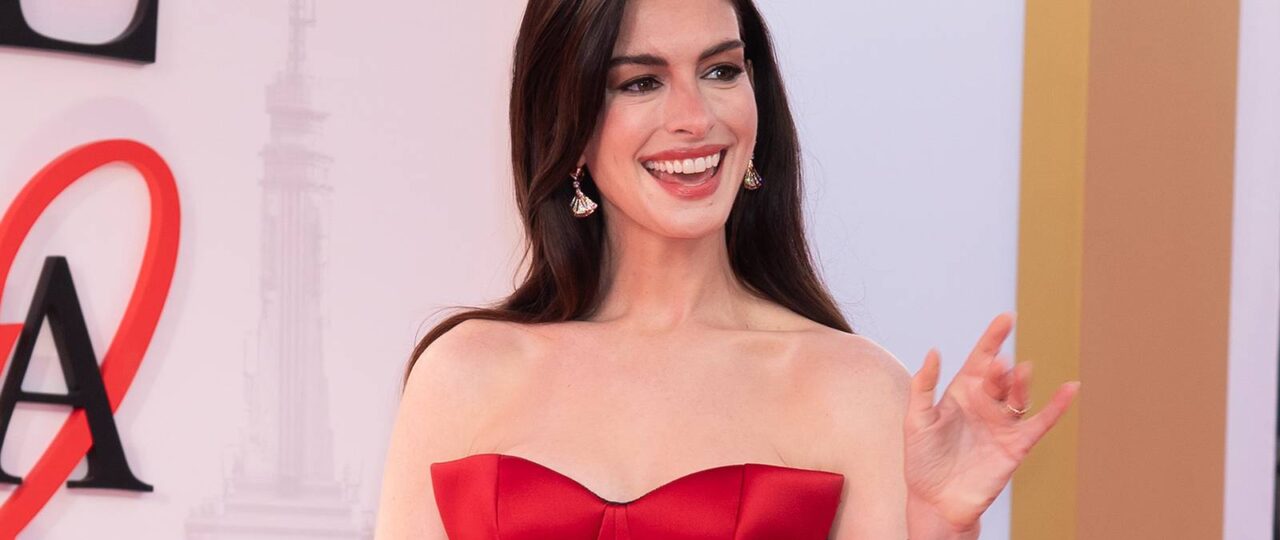
Anne Hathaway has given us some of the most iconic characters of recent decades, from Catwoman in The Dark Knight Rises and Dr. Amelia Brand in Interstellar to, of course, Andy Sachs in The Devil Wears Prada. Fans got to see plenty of Hathaway on the big screen this year, starting with her return as Andy in The Devil Wears Prada 2, then as Penelope alongside Matt Damon‘s Odysseus in Christopher Nolan‘s The Odyssey. She also co-led David Robert Mitchell‘s The End of Oak Street, alongside Ewan McGregor, where she faced off against dinosaurs in the twisty sci-fi mystery.
Among her many performances this year, there’s one feature that did not get its due. The performance in question is in the psychological drama, Mother Mary. Directed by David Lowery, the feature sees Hathaway as a troubled, global pop icon and Michaela Coel as her estranged former costume designer and lover. While the audience is accustomed to a tense character study when it comes to a pop star’s story, the narrative pivots into haunting surreal supernatural horror. We follow Mother Mary (Hathaway), who flees her life in Los Angeles after a highly public, emotional breakdown backstage during her tour. She arrives uninvited at the remote estate of Sam Anselm (Coel), her former lover, and the visionary designer who originally built Mary’s public identity and mythology. When Mary begs Sam to design a “resurrection dress” for a career comeback concert, the two women work together. But soon their deep resentment, guilt, and artistic obsession surface, and the film quickly shifts from a tense psychological battle into a gothic metaphysical fantasy.
Lowery directs from his own script and touches upon the themes of the cost of fame and modern stardom; through Mary and Sam, we explore the blurred lines between the muse and the creator, examining whether an artist can ever truly possess their own identity. With its music-video-inspired cinematography, high fashion costuming, and compelling performances, the movie earned a 69% Rotten Tomatoes rating. However, it proved a commercial disappointment, earning $3 million worldwide on a relatively high $20 million budget.
Four franchises, four completely different ways of getting underneath
your skin. This is the one built out of your particular fear, why it works so well on you, and what
it would leave behind.
Your nightmare does not wait outside the door. It waits for you
to close your eyes, which you are going to have to do eventually, because nobody has ever
won that particular argument.
- Freddy is horror’s cruellest idea: a threat that lives in the one place you cannot
guard, cannot lock, and cannot avoid forever. - You are the one who is fine during the film and wide awake at two in the morning. Your
own head is where this does its damage. - These films understood exhaustion as a horror engine. The kids on Elm Street do not lose
because they are weak. They lose because they are tired. - You can lock every door in the house. You still have to sleep.
Your nightmare is not really the doll. It is the face of the
person you tell, and the way they decide, very kindly, that you have imagined all of it.
- Chucky works precisely because he is absurd. That is the trap: the more accurately you
describe him, the less anybody is going to believe you. - You are the one shouting at the screen because the characters are not listening. You
know that feeling from real life too. - The franchise is at its best when the adults in the room are the real obstacle, and you
have met those adults. - By the time somebody finally believes you, you will have handled most of it on your own.
Your nightmare has your number, knows your name, and has almost
certainly been inside your house before. The worst part is that you already know them.
- Scream is the only one of these where the killer takes the mask off and turns out to be
somebody who was at the party. - You are the person who calls the twist out loud before it lands. You watch people the
same way you watch films. - The franchise made the rules of horror part of the plot, which means the survivors are
the ones paying attention. You would be paying attention. - Everybody is a suspect, including the person who just offered to walk you home.
Your nightmare is not really about you. It is about the people
asleep down the hall, and the feeling that whatever is here is not interested in leaving.
- The Conjuring films are domestic horror. The house, the family, the perfectly ordinary
room that quietly stops feeling ordinary. - Your instinct is to get everybody into one room. Your fear is protective rather than
personal, which is rarer than it sounds. - This is the one franchise where belief is the weapon. The people who come through it are
the ones who are not alone and refuse to be. - Whatever is here did not come for you. It came for the household, and you are the one
standing in the hallway.
‘Mother Mary’ Gets its Due on Streaming
Mother Mary isn’t the first movie this year that has found a global audience after box office failure — movies like In the Grey and Masters of the Universe have exploded on streaming — and it won’t be the last. Mother Mary has claimed the top spot on HBO Max’s global top 10 charts, as per FlixPatrol. The chart also includes films like Gremlins, Contagion, Evil Dead Burn, and The Northman, among others.
Stay tuned to Collider for more such updates.
Mother Mary
-
<
 Enjoying this article? Support our work with a small crypto donation.
Mother Mary
-
<
Michaela Coel
Sam Anselm
-
<
Hilda
-
<
FKA Twigs
Imogen



Discover more from NAIRAVOICE.COM.NG
Subscribe to get the latest posts sent to your email.