 There’s a lot that needs to be done for the Red Sox before the team can reasonably expect to break its habit of early postseason exits.
Work remains for the roster. This week again showed that the lineup isn’t nearly good enough for a deep October run. Further, the organization must determine, once and for all, how to keep Roman Anthony healthy.
But before any of that can be done — rosters are essentially frozen until after the conclusion of the World Series – the Red Sox have a more immediate problem to address.
In the clubhouse late Wednesday night, there was the requisite amount of sadness and disappointment that always goes hand-in-hand with a season-ending loss.
Not only had the team again been knocked off in the first round by its biggest rival, but it had suffered embarrassing defeats on both games. The Red Sox never led in either game and were collectively outscored 18-2.
It’s bad enough to get swept, as the Red Sox were. It’s worse when the only two playoff games you took part in were, in the words of Isiah Kiner-Falefa uncompetitive.
Humiliation doesn’t look good on anyone, and the emotions post-game Wednesday were, predictably, raw and ugly. That comes with the territory.
But there was something else evident in the clubhouse, too, with potentially long-lasting repercussions: There were traces of betrayal.
The Sox lost twice in lopsided fashion, and there was enough sting there to last a chunk of the offseason. Even that can be somewhat beneficial, serving as fuel to improve and motivation for the future.
But this was something else, and perhaps only felt by the more veteran players: the feeling that they been done a disservice by some in-game moves.
It was one thing when Payton Tolle got lifted in Game 1 after 83 pitches — given his climbing pitch count and relative inexperience, a case could made that it was time to go to the bullpen, even if the choice to replace him with Erik Miller backfired immediately and spectacularly.
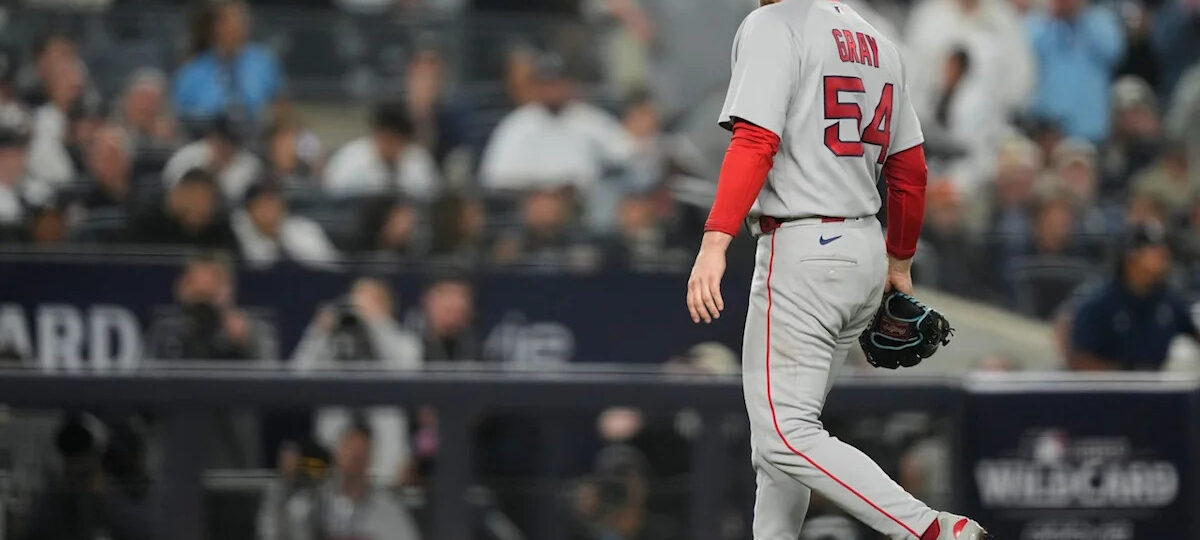
But when Chad Tracy — or someone — decided it was time to take out Sonny Gray in Game 2 after just 70 pitches, a line was crossed. Gray is a veteran of 14 seasons, with better than 350 career starts to his credit.
Moreover, as Gray himself later offered, he typically gets better not weaker as he goes deeper into games. Facing a lineup for the third time over the course of this past season, Gray held opposiing hitters to a .180 batting average.
The failure to recognize and honor that ability in the middle of the biggest game of the year had to feel like a show of disrespect — not just to Gray, but also, many of his teammates.
Indeed, without naming names, Gray made a point to note that others in the room were as surprised and disappointed as he was. Perhaps that, too, explains the emotional nature of Gray’s embraces as he toured the clubhouse before speaking with the media. It’s possible that not only was he saying goodbye to his colleagues — Gray has yet to say whether he’ll continue to pitch — but also, his teammates were offering their own support, out of solidarity.
Not only had their season ended, but many in the room believed Gray had been disrespected.
On a macro level, there was another layer of disenchantment: Who made the call to lift Tolle and Gray prematurely? Was it their manager, who long ago had earned their trust with his belief in them at their collective low points? That didn’t align.
Or did the players suspect that Baseball Ops – and more specifically, chief baseball officer Craig Breslow — was behind the decision? That Breslow himself had a long career as a player might help mitigate some of that resentment, but wouldn’t fully exonerate him. Players like to know that their in-game fate is being decided by someone in uniform, and not by some less visible source.
Willson Contreras, who carries enormous weight within the clubhouse due to his experience and force-of-nature personality, openly addressed the over-reliance on analytics, a talking point that has bubbled just beneath the surface for much of the season.
(When Kiner-Falefa spoke in vague terms of the crowded clubhouse earlier in the year, he was making reference to the analysts who sometimes invaded the player’s space). And pushback from the players eventually led to the team severing ties with Driveline’s Kyle Boddy, head of the data-driven consulting company involved with the team’s hitting instruction.
And now, in the postseason, with everything on the line, Contreras voiced resentment with the team’s sometimes slavish devotion to analytics.
It’s 2026, and analytics are now a long-established, intrinsic part of the game — a tool utilized in player evaluation, projection and player development. It’s part of the discussion when teams are weighing trades or free agent signings and disregarding it would be malpractice.
But players draw the line when it takes precedence over common sense and dictates in-game strategy. And, as Theo Epstein has recognized, modern players now expect concrete answers when they’re asked to do certain things.
That doesn’t mean that Red Sox management owes players an explanation for everything.
But after Wednesday night, the Red Sox would do well to re-think how they communicate with their players and attempt to rebuild some of the trust that was broken in the wild card round.
More Red Sox coverage
Read the original article on MassLive. Add MassLive as a Preferred Source by clicking here.
Discover more from NAIRAVOICE.COM.NG
Subscribe to get the latest posts sent to your email.