
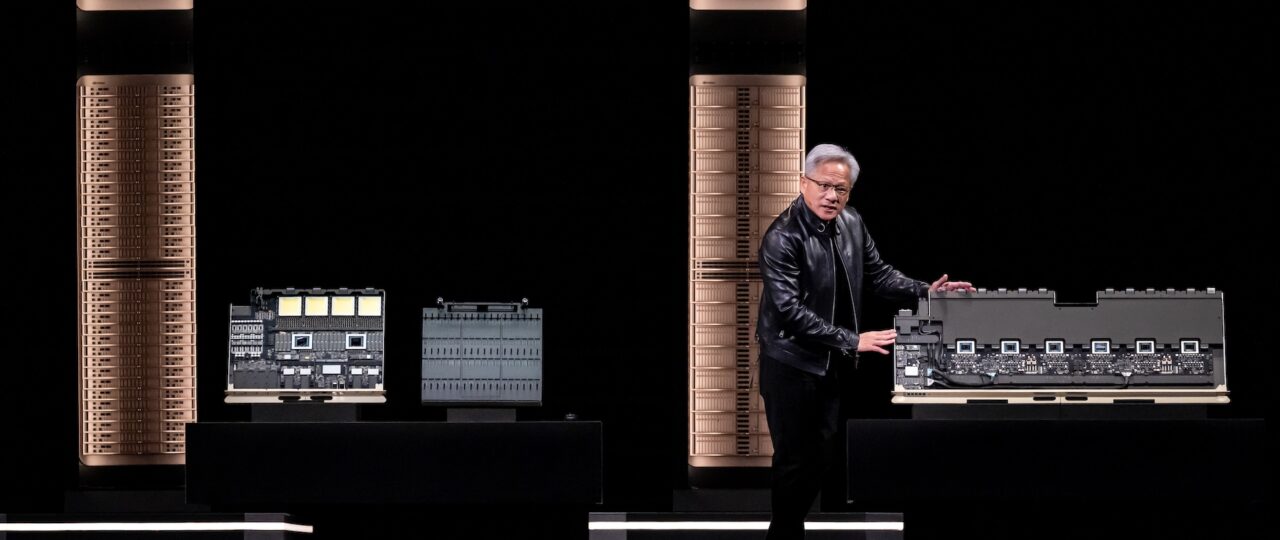
Aside from AWS, Kress said Wednesday that Nvidia expects Vera to be deployed by “every major hyperscaler, neocloud, AI lab, and system OEM, with shipments already underway to our lead partners,” which include Oracle and SpaceXAI.
The partnership is also extending to Amazon’s warehouse robots and enterprise offerings.
Kress said Amazon plans to adopt Nvidia’s full physical AI stack to power its fleet of robots. The stack includes Omniverse (its simulation and digital twin platform); Cosmos (its world model platform); Isaac (its robotics development platform); and Jetson (computing hardware for robots and edge AI). This week, Nvidia also introduced a new version of Jetson designed as a more accessible robotics computer for “entry-level edge AI.”
On the enterprise side, AWS will serve Nvidia’s Nemotron family of open models on Amazon Bedrock, its managed foundation model platform, and SageMaker, its managed cloud service.
Nvidia also reported Wednesday that it recorded sales of $96.2 billion for the second quarter, beating analyst estimates. Data center revenue made up the majority of Nvidia’s sales for the quarter at $89 billion, up 117% from a year ago.
Nvidia said it expects revenue to reach $108 billion in the third quarter, some of which will come from its next-gen Rubin GPUs. Nvidia said it began production shipments this quarter. Investors have been looking out for Rubin’s initial Q3 sales for signs that demand will continue into Nvidia’s next generation of hardware.
Nvidia has committed $279 billion to secure supply and manufacturing capacity for current and future data-center projects, up substantially from $119 billion last quarter, as the chipmaker looks to secure memory and manufacturing capacity to meet AI demand over the next few years. That commitment includes $92 billion in projected spending for the rest of the fiscal year and another $87 billion in fiscal year 2028.
“The thing that matters for the industry is that AI is now doing productive and useful work,” Huang said during Wednesday’s call. “AI is generating profitable tokens… If we had more compute, we could generate more profitable tokens, which results in more profit for all of the services. This is the exact phase where we’re at, which is the reason why everybody’s leaning in.”
Investors will be watching to see if additional compute indeed translates so neatly into additional profits as AI companies pour hundreds of billions of dollars into infrastructure.
Discover more from NAIRAVOICE.COM.NG
Subscribe to get the latest posts sent to your email.