Every morning for two weeks, health and performance coach Dan Go woke up and checked his fitness wearable.
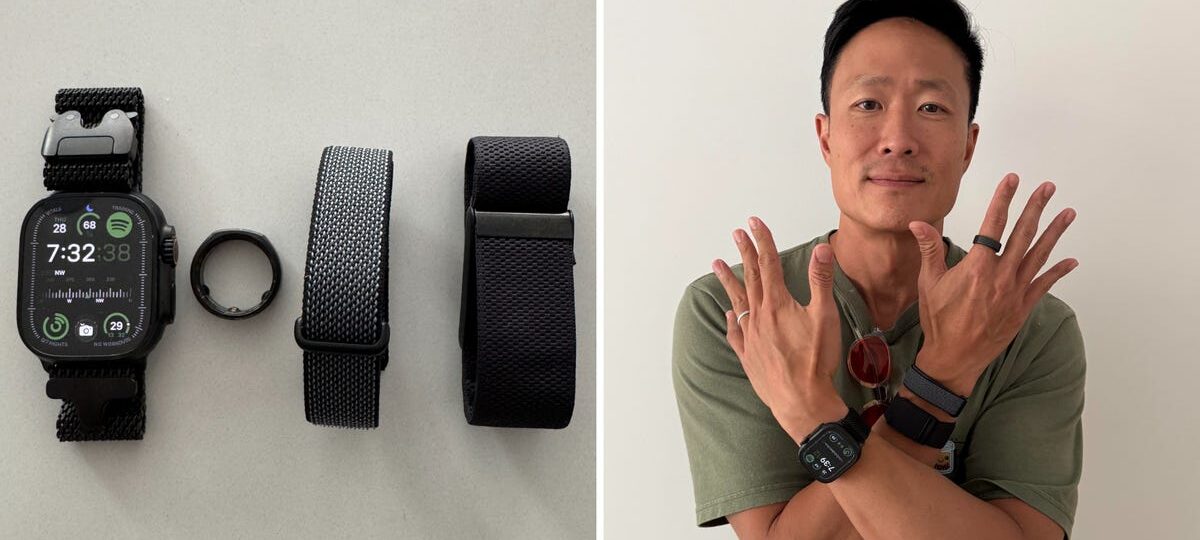
Go, 46, was wearing four different devices at once, his latest self-experiment to find the best strategies for health and fitness. “I’ve always wanted to do this test for my own curiosity, so I could see which one came out on top,” he told Business Insider.
Go, who is based in Toronto has been a trainer for over a decade, mainly working with entrepreneurs to improve their work and home lives by optimizing their health.
His clients are very interested in picking the right wearable.
To compare factors such as accuracy and convenience, Go tried an Apple Watch, a Whoop, an Oura Ring, and a Fitbit Air simultaneously.
He had tried them before, but never head-to-head.
While two weeks is a very short window for a health experiment, Go said it was enough time for him to pick a clear winner for overall performance and which device he prefers for himself, day to day.
Here’s what he picked, and what he recommends to clients seeking sustainable fitness.
Go said each device had unique advantages and tradeoffs: Apple and Fitbit declined to comment on Go’s specific choices.
Oura did not respond to Business Insider’s request for comment.
Go said the Oura Ring is a strong contender.
The first time he tried it, before this head-to-head experiment, the data inspired him to drastically improve his sleep habits.
The data was clear, encouraging, and not overwhelming. “I improved my sleep, going from someone who had trouble going to sleep to someone who went straight to sleep and was able to stay asleep throughout the entire night,” he said.
He doesn’t recommend it, though, because he found himself taking the ring off too often.
Instead, his top pick — and the one he recommends to clients — is the Apple Watch.
While it’s a bit more expensive up front, it doesn’t require an ongoing subscription to use like Oura or Whoop.
Go found it to be the most reliable of the four devices: The step count tracked closely with the pedometer, and it tended to match his subjective sense of being rested (or not). “Apple Watch was the most accurate in terms of comparing how I felt to the metrics I was getting,” he said.
Go said that while he expected some variability between devices, they were a lot less consistent than he expected. “One of the most surprising things to me was that the Whoop was over-exaggerating the amount of steps I was taking,” he said.
For sleep, Go didn’t test the devices in a sleep lab where they can control for various factors to come up with an evidence-based verdict.
Instead, he used his Apple Watch score as a benchmark, based on the Journal’s study that found it to be the most accurate.
Compared to the Apple Watch, he found that the Whoop sleep score exaggerated how poorly he slept.
Emily Capodilupo, senior vice president of research at Whoop, told Business Insider that the company is continually working to improve the device’s algorithms and hardware. “Our sleep algorithms have been evaluated against the clinical gold standard of polysomnography, and we’re proud of the accuracy we’ve achieved across sleep and other key health metrics,” Capodilupo said.
Even with some variability, though, wearables can still be useful for most people because they help identify patterns of change over time.
Unless you’re a pro athlete, you probably don’t need precise numbers to tell if you’re making progress. “The average person that’s going to use these things is a weekend warrior,” Go said. “They’re not necessarily trying to eke out the last percentile of their potential.
You just need the general direction of where these numbers go.” He also wasn’t too concerned with the devices’ recovery scores — a rough estimate of how well the body is handling stress and physical strain, estimated with data like resting heart rate — because they rarely matched how he actually felt.
Unless the devices showed a drastic change, he didn’t let a low score derail his day, and would finish a planned workout even if a device recommended that he rest instead. “Something that we have to realize about the human body is that it is so resilient,” he said.
Go said he plans to forgo the devices for the foreseeable future, since he felt all the self-tracking data was becoming more stressful than helpful.
He already tested a wearable-free life for a couple of weeks earlier this year, and didn’t miss them, so he now wants to try it out long-term. “I’m going back to using no wearable because the constant attack of being told…, ‘This is how you should feel.
This is how you should perform.’ It actually does have an outsize impact on my psychology,” Go said.
His advice for clients: Try whichever wearable best fits your priorities, based on the above criteria, and use it for four to eight months to notice some patterns.
Then, ditch the device and focus on listening to your body. “I am not anti-wearable.
I will still wear them from time to time,” he said. “But at some point, you have to be able to let go of the training wheels.
Once you have the data and you have a good handle on it, then you will want to evolve toward how you feel.”
Discover more from NAIRAVOICE.COM.NG
Subscribe to get the latest posts sent to your email.