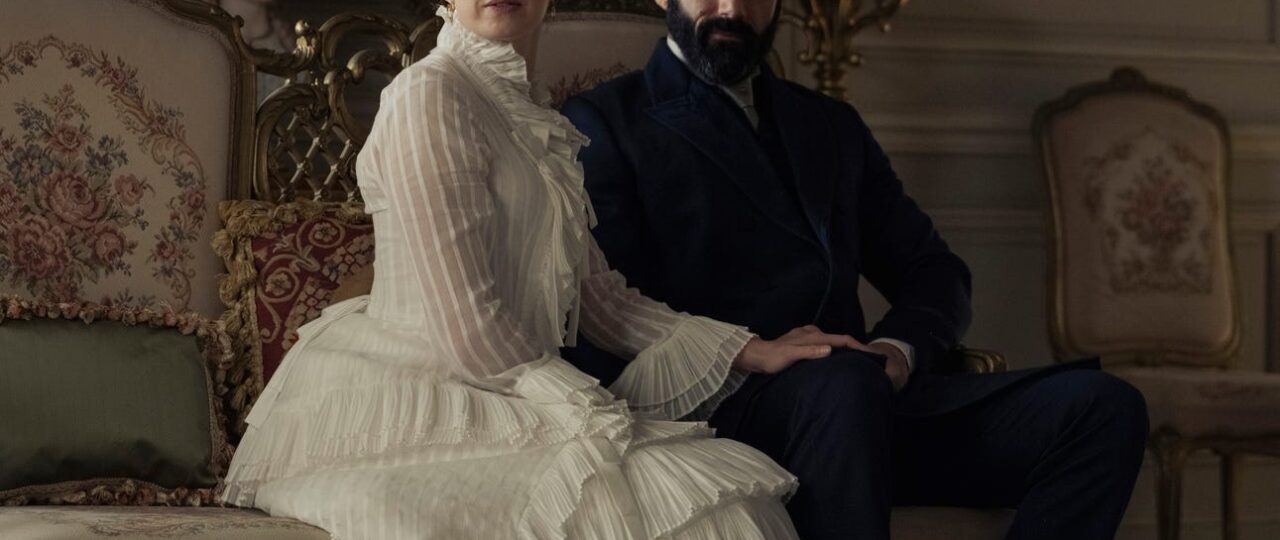

- Season four of “The Gilded Age” premiered on November 1.
- While some of its characters are fictional, the show is populated with real people from the era.
- Grover Cleveland, Booker T. Washington, Oscar Wilde, and Clara Barton have all popped up.
Few eras have captivated people more than the Gilded Age, a period in the late 19th century characterized by extreme wealth (and wealth inequality), progress, immigration, and a certain ruthlessness among the age’s businessmen.
The show is populated by a mix of entirely fictional creations and a few characters who differ only in name from real people of the time.
Here’s a guide to every real person who made the jump from history books to HBO in “The Gilded Age.”
Warning: There are some season three and four spoilers ahead.
Carrie Coon plays Bertha Russell, who’s based on Alva Vanderbilt.
Alva Vanderbilt Belmont was a Gilded Age socialite who married William K. Vanderbilt, a Vanderbilt railroad heir. In 1882, the couple built a mansion that took up a whole city block on Fifth Avenue in New York City — much like the mansion the Russells move into in the series premiere.
Bertha isn’t exactly Alva, but the similarities are there, including Alva’s hunger and determination to be accepted by the upper crust of New York society, her strong personality, and love of the opera.
Taissa Farmiga plays Bertha’s daughter Gladys, based on Alva’s daughter Consuelo.
If there was any doubt that Bertha and Gladys were based on Alva and Consuelo, that doubt ended when Gladys married off to a British duke against her will, in order to elevate her family’s status and credibility.
While Gladys and Hector’s relationship was at a high point at the end of season three — though, after the season four premiere, there seems to be a major conflict incoming — if you don’t want to know what could happen to Gladys, skip ahead.
In real life, Consuelo’s marriage to Charles Spencer-Churchill, 9th Duke of Marlborough, was largely an unhappy one, though she and her husband mostly lived separately.
They separated in 1906 and were officially divorced in 1921. The marriage was annulled in 1926.
However, Bertha’s husband George (Morgan Spector) isn’t based on a Vanderbilt. Much of his character comes from Jay Gould.
George is portrayed as a full-blown robber baron, much like Gould was. In fact, Gould is remembered as one of the most cutthroat railroad tycoons of the Gilded Age.
As his Encyclopedia Britannica entry notes, he “remained ruthless, unscrupulous, and friendless to the end” before his death in 1892. George is similarly unafraid to cross anyone, as long as it benefits his bottom line.
And much like Gould, while George spares no feelings for his competition, he has shown great love for his wife and children — and, as fans of the show have pointed out, is quite handsome. They even call him “Railroad Daddy.”
Peggy Scott, as played by Denée Benton, is inspired by a few real women, including Julia C. Collins.
One of the first things we learn about Peggy is that she’s an aspiring writer, and a talented one at that. It’s clear that “Gilded Age” creator Julian Fellowes was inspired by Julia C. Collins, the first Black female author to publish a novel.
Collins’ book, “The Curse of Caste; or The Slave Bride,” was published in serial form across eight months in 1865. However, she died of tuberculosis before she was able to finish it.
Thankfully, Peggy has fully recovered from the illness she contracted at the beginning of season three … and it introduced her to Dr. William Kirkland, her now-fiancé.
Donna Murphy plays Caroline Schermerhorn Astor, the queen of New York high society.
During the Gilded Age, the undisputed queen of New York was Caroline Schermerhorn Astor, who, despite her husband William Backhouse Astor Jr.’s enormous wealth, was actually the richer of the two due to her family’s wealth dating back to the first settlement of Manhattan by Dutch colonists in the 1600s.
Astor was the leader of a group called the Four Hundred, a list that contained anyone who was anyone in the late 1800s. Perhaps coincidentally, her townhouse’s ballroom could fit up to 400 people comfortably.
Murphy, a two-time Tony Award winner, brings needed gravitas to the role.
Just like in the show, her third daughter, Charlotte Astor Drayton (played by Hannah Shealy), caused a scandal with her divorce.
The real Charlotte Astor married J. Coleman Drayton in 1879, and their relationship made headlines in 1892 when he challenged another man, Hallet Alsop Borrowe, to a duel following rumors of an affair between Borrowe and Astor. The fight didn’t happen, but the Draytons divorced in 1896.
The scandal gets its own storyline in “The Gilded Age.” The show depicts how divorce — as experienced by both Charlotte Astor and fellow socialite Aurora Fane (Kelli O’Hara) — sees women cast out of society. It is shocking to the establishment, therefore, when Bertha Russell invites both Charlotte and Aurora to her Newport ball, suggesting society is opening its arms to divorced women.
Caroline’s youngest daughter, Carrie Astor, is played by Amy Forsyth.
Carrie Astor has had a recurring role throughout “The Gilded Age,” popping up in four seasons mainly to convince her mother to let the Russells join their elite circle of friends.
If the show follows what happened in real life, Carrie’s future marriage to banker Marshall Orme Wilson will cause quite a stir, as her parents did not approve of the match. In fact, according to a biography of the Astors, Carrie “starved herself into bulimia” until her mother acquiesced.
One of the show’s more eclectic characters is Mamie Fish, played by Ashlie Atkinson.
Fish is one of the first people we meet in “The Gilded Age” when Bertha and George’s son, Larry, is invited to vacation at her home in Rhode Island.
In real life, Fish was another of the era’s most powerful socialites, alongside Alva Vanderbilt and Tessie Fair. The three ruled as the “Triumvirate” after Caroline Astor’s death in 1908.
In both fiction and real life, Fish loved to throw a lavish party.
Caroline Astor’s right-hand man, Ward McAllister, is played by Nathan Lane, distinct mustache and all.
McAllister is the one who dictated the official “Four Hundred” list to The New York Times in 1892.
In the show, Bertha has been seen sucking up to McAllister to help her get in good graces with the Astors.
But in the penultimate episode of season three, McAllister was officially put out to pasture by the ladies of NYC high society, as he published a tell-all book that did not endear him to, well, anyone.
This happened in real life, too — McAllister published his memoir, “Society as I Have Found It,” in 1890, which left him excommunicated from Manhattan’s elite.
While trying to make it as a writer, Peggy meets Timothy Thomas Fortune, played by Sullivan Jones.
After deciding not to take her name off her writing to be published in white newspapers, Peggy meets Fortune, the real publisher of The New York Age, a leading Black newspaper of the day (called The New York Globe in the show).
In both the show and reality, Fortune was married by the time of “The Gilded Age,” but it didn’t stop Peggy and Fortune from developing a relationship during season two.
John Sanders plays the famous (and problematic) architect, Stanford White.
If you’ve ever walked around Washington Square Park in Manhattan, you’ve seen one of White’s most renowned pieces of work: the Washington Square Arch.
In the show, White is also responsible for designing the Russells’ behemoth of a townhouse on Fifth Avenue.
In real life, White was involved in one of the era’s biggest scandals. When he was 48, he was accused of drugging and sexually assaulting 16-year-old Evelyn Nesbit, a model and actor.
In 1905, when Nesbit was 21, she married another prominent New York figure, Henry Kendall Thaw. When Thaw learned what White had done to his wife, he murdered him during a performance at Madison Square Garden (a building he designed).
The subsequent trial was a media circus and was even dubbed the trial of the century. Public opinion of White plummeted during the trial when the public learned about his private life. According to The New York Times, Vanity Fair even ran this headline: “Stanford White, Voluptuary and Pervert, Dies the Death of a Dog.”
Thaw was found not guilty by reason of insanity.
Clara Barton, as played by Linda Emond, appeared in the first season.
In season one, Marian (Louisa Jacobson) takes her aunts to a talk by Barton, a Civil War nurse, voting-rights and equal-rights activist, and a key member of the American Red Cross.
J. P. Morgan, as played by Bill Camp, joined the cast in season three.
The real Morgan was considered the greatest banker who ever lived, so it shouldn’t be surprising that George, in need of capital, would turn to him for help.
Jordan Waller played Oscar Wilde in a season two episode.
The famous playwright and author of “The Portrait of Dorian Gray” popped up in season two while his play “Vera; or, The Nihilists” premiered in New York. Of course, he found time to hit on John Adams (Claybourne Elder), as well.
Emily Warren Roebling, one of the engineers of the Brooklyn Bridge, was played by Liz Wisan in season two.
Roebling essentially took over for her husband, Washington Roebling, as chief engineer of the Brooklyn Bridge after he developed decompression sickness and became bedridden.
The Brooklyn Bridge is unveiled during a season two episode, and George sends his son, Larry (Harry Richardson), to represent him at a trustees meeting, when he discovers that Emily is the one running the show.
Suffragist Sarah J. Garnet, as played by Melanie Nicholls-King, appears in season two as well.
Nicholls-King appeared in three episodes of season two as Garnet, a landmark figure in Black history, as she was a principal, the founder of the Equal Suffrage League, and the owner of her own seamstress shop.
There are two public schools in New York City named for Garnet today.
Booker T. Washington, played by Michael Braugher, also appeared in two episodes of season two.
Washington is known for his work advancing the education of Black Americans in post-Civil War America, including serving as the first leader of the Tuskegee Institute, now the HBCU (Historically Black College or University) Tuskegee University.
Washington is in two episodes of the second season, when Peggy and Fortune make their way to Tuskegee to report on it for the newspaper.
Gladys gets her portrait done by artist John Singer Sargent (played by Bobby Steggert).
Sargent’s season three appearance is in 1883, just before he became famous for his painting “Portrait of Madame X” in 1884 — in fact, he mentions the then-scandalous painting while speaking with Bertha, who notes that some scandal will only make him more expensive.
Gladys’ husband, Hector Vere, the Duke of Buckingham, is based on Charles Spencer-Churchill, the Duke of Marlborough. He’s played by Ben Lamb.
In the show and in real life, this duke was desperate for a sizable dowry so he could continue the upkeep on his castle (Sidmouth Castle in the show, Blenheim Palace in real life).
However, so far, Hector seems like he’ll be a better husband to Gladys than Charles Spencer-Churchill was to Consuelo Vanderbilt, although he does keep a major secret from Gladys in the season four premiere.
Frances Ellen Watkins Harper is played by LisaGay Hamilton in season three.
Peggy brings Harper to a ladies’ tea she’s hosting to help drum up support for the suffrage movement, much to the displeasure of the conservative Elizabeth Kirkland (Phylicia Rashad).
Harper was one of the first Black female authors to be published — and left behind a large body of work — and also was an activist for suffrage, temperance, and abolition.
Russell Risley Sage, played by Peter McRobbie, joined the show in season three.
When George is summoned to a meeting by J. P. Morgan, he meets other financiers, including Sage.
Sage, in real life, worked closely with Jay Gould (if you’ll recall, the basis for George’s character). The two managed railroads together. However, in “The Gilded Age,” the two have a much more adversarial relationship.
Sage is perhaps most famous for surviving an assassination attempt at his office by using one of his employees, William R. Laidlaw Jr., as a human shield. Laidlaw survived but sued Sage after he was permanently disabled.
As The New York Times put it, Sage was found to owe him $25,000, “simply because he used William R. Laidlaw, Jr., as a shield to save his gray hairs from being brought prematurely to the grave.”
President Grover Cleveland, as played by Jim Gaffigan, will make his debut in season four.
Gaffigan was announced as part of the season four cast in March by Deadline.
The comedian hasn’t popped up yet, but much has been said about the president visiting Ada and Agnes’ home as a way to connect with the city’s elites, so we can surely expect Cleveland — who was also the governor of New York from 1883 to 1885 — to show up soon.
Cleveland’s Secretary of the Treasury, Daniel Manning, will be played by Dallas Roberts.
Manning was a key figure in Cleveland’s path to clinching the Democratic nomination, and later, his (first) win for the presidency. To thank him, Cleveland appointed Manning as Secretary of the Treasury, a position he held until 1887.
John D. Rockefeller, the world’s first billionaire, will finally pop up in season four, played by Neal Huff.
That all began with John D. Rockefeller, who founded Standard Oil in 1870 and was, at one point, the richest man in America. He was also huge in the railroad business, so he’ll probably show up in scenes with George and the other robber barons.
Real-life journalist Louisa Knapp Curtis will be played by Bonnie Milligan.
Milligan, a Tony Award winner, posted on Instagram about joining the cast, writing, “I cannot even begin to tell you how excited I am for this!!! I have loved @gildedagehbo since episode one, and to get to delve into this glorious world, is the thrill of a lifetime!”
She’ll be playing Curtis, the very first editor of Ladies’ Home Journal, a real magazine that was published from 1883 to 2016. She was in charge from 1883 to 1889. Before that, she had her own column in her husband Cyrus Curtis’ Philadelphia newspaper, Tribune and Farmer.
As Peggy is our resident journalist, we can only hope she’ll interact with Louisa.
Correction — August 4, 2025: An earlier version of this story misidentified the actor who plays Gladys Russell. She’s played by Taissa Farmiga, not Vera Farmiga.
Editor’s Note: This story was originally published in August 2025 and most recently updated in November 2026.
Read the original article on Business Insider
Discover more from NAIRAVOICE.COM.NG
Subscribe to get the latest posts sent to your email.