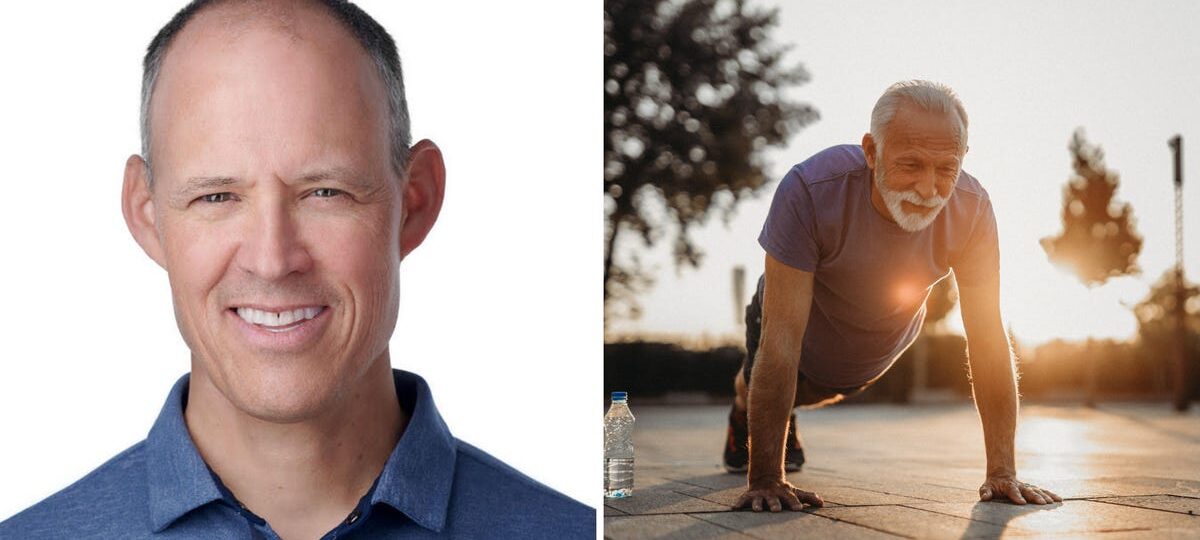
Christopher Sciamanna hates to exercise.
That’s why he’s focused his career on making workouts less “soul-sucking,” according to his bio on X, helping people do the least while reaping the most benefits for a long, healthy life.
The minimal effect dose of exercise might be as little as 4 minutes a day to build the strength and resilience we need for better longevity, according to his latest research.
A professor of medicine at Penn State, Sciamanna told Business Insider that every second of activity counts. “From a health perspective, the real goal is taking people from zero to one, to a little bit,” he said. “What we’ve learned is that people who need exercise the most are not going to consider 45 minutes.” At 59 years old, Sciamanna said the work has also inspired him to simplify his own exercise routine, offering key takeaways on how to make the most gains in the shortest workouts possible.
You don’t need to spend an hour a day in the gym for a longer, healthier life, Sciamanna said.
Two hours a week of strength training is enough to build strength and muscle, experts previously told Business Insider, and to improve longevity, according to recent research published in the British Journal of Sports Medicine.
Sciamanna published a study of his own that adds to the trove of evidence supporting short bursts of exercise.
He wanted to see whether his patients, aged 65 and older, could get away with even less, doing a daily series of simple at-home exercises for 30 seconds each.
The full workout, totaling 4 minutes, included push-ups, squats, stair-stepping, and resistance-band rows, with 30 seconds of rest between movements.
Participants could modify the exercises as needed, doing wall push-ups or chair squats, and gradually working up to more challenging variations.
After 12 weeks, the participants, who had trouble walking at the start of the study, saw significant improvements in their ability to stand up and to balance on one leg.
These factors are known as mediators — metrics that predict people’s ability to get around, which in turn, have been strongly linked to healthier aging and lower mortality rates.
The study, the results of which were published in the journal PLOS One, was in part inspired by Sciamanna’s parents. “I had this kind of epiphany that if my parents had done just a set of push-ups and a set of squats every day, they probably would’ve been able to maintain their mobility and independence,” he said.
More research is needed on the long-term and longevity benefits of Sciamanna’s quick-results protocol (known as FAST: Functional Activity Strength Training), he said.
But previous evidence shows that minute-long sets of strength exercises, such as wall sits, translate into protective benefits, including lower blood pressure.
Crucially, Sciamanna said the short workouts worked because people could stick to them, building confidence over time rather than feeling intimidated and dropping out. “The specter of failure and how that will feel to you is really demotivating, ” he said.
Psychologically, it works great because humans love the feeling of making progress.” While Sciamanna’s most recent study focused on people over 65, it offers insights for younger people too: consistently challenging your body with short, challenging exercises can make you stronger and healthier.
He uses the same idea for his own gym sessions: doing one hard set of each exercise so he’s in and out in less than half an hour, twice a week. “One of the most important pieces of this is that one set is all you need.
A couple of times a week, a single set and you’ll get 80% of the strength,” Sciamanna said. “Your first dose is really where you get all the benefit.” There’s extensive research to back him up, showing that the majority of benefits in the gym come from the first few sets of exercise.
Sure, you’ll build more muscle and strength with more sets, but there are diminishing returns — the longer you work out, the less additional benefit you’ll gain from each extra set.
The catch is that each set needs to be hard, and you need to increase the challenge over time, a principle known as progressive overload.
To save more time, Sciamanna’s go-to exercises are compound movements like chest presses, pull-ups, and farmer carries that work multiple muscle groups at once.
But longevity isn’t just about building strength.
Sciamannas said he particularly loves box jumps because they help improve multiple fitness markers for healthy aging, like agility, speed, and balance.
As a bonus, they help him stay fit enough to enjoy sports like racquetball, pickleball, and keeping up with his 25-year-old son. “I think speed is really the next frontier of this work because aging is a loss of speed problem.
Discover more from NAIRAVOICE.COM.NG
Subscribe to get the latest posts sent to your email.