The 2026 FIFA World Cup is going to look and feel different from any version that came before it.
The expanded 48-team format, explained by The Athletic, is built to rewrite the record book of the world’s most-watched sporting event.
More teams, more games and a deeper pool of elite talent mean some of the sport’s most cherished World Cup marks are suddenly in real danger.
The United States, Mexico and Canada will host the World Cup beginning Thursday, June 11. The tournament culminates in the World Cup final on July 19 at MetLife Stadium in East Rutherford, N.J.
With 48 teams and 104 total matches (up from 32 and 64 in 2018 and 2022), there are simply more opportunities than ever before for players and nations to chase history.
Here are some of the current World Cup records most likely to fall in 2026.
Most goals scored in a single World Cup by a team
The current benchmark for team firepower in a single World Cup sits at 27 goals, set by Hungary in 1954. That tournament featured a different tactical era and far fewer games. The second-highest goal total is 25, turned in by West Germany during the same World Cup. But 2026 will offer offensive juggernauts more chances than ever to run up the score.
Powerhouses like Brazil, France and England will all expect deep runs, and a favorable group draw could hand someone a lopsided scoreline or two that was much harder to find in the 32-team era.
Recent champions have already flirted with huge tallies: Germany scored 18 in 2014, while France hit 14 in 2018, showing how close modern attacks are to the mid-20s even in shorter formats.
Most goals in a single World Cup by a player
Just Fontaine’s 13-goal outburst for France in 1958 has stood for almost seven decades, largely because modern tournaments feature tighter defending and more balanced scoring. The expanded format changes some of that math.
A star forward who plays all the way through the new six- or seven-game path to the final will have more minutes and likely more group-stage mismatches to feast on. The likes of Kylian Mbappé of France, Erling Haaland of Norway, Harry Kane of England or another emerging star will arrive in 2026 with club-level scoring resumes that dwarf anything from Fontaine’s era.
Most total goals in a World Cup
The move to 104 matches in 2026 almost guarantees the all-time record for total goals at a single World Cup will at least be challenged. The high watermark in the 32-team era was 172 goals, hit in Qatar in 2022.
Even if the goals-per-game rate dips slightly as the field broadens, the sheer volume of fixtures tilts this record in favor of a reset. Styles have also shifted toward more aggressive pressing and transition play, which can open up games, especially when top-seeded teams face overmatched opponents in the early stages.
Youngest goal scorer in World Cup history
The World Cup has always produced breakout teenagers, and the expanded field increases the odds that a prodigy grabs a slice of history. The current mark for youngest scorer is held by Pelé, who was 17 years and 239 days old when he scored for Brazil at the 1958 World Cup.
More teams means more countries dipping into their youth ranks for attacking spark. North American hosts will feature heavily in that conversation, with both the United States and Mexico traditionally leaning on young talent and Canada pushing a new wave of attackers into the spotlight heading into 2026.
Highest-scoring match in World Cup history
Austria’s 7-5 quarterfinal victory over Switzerland in 1954 still stands as the highest-scoring game in World Cup history. In the modern era, group-stage blowouts are less common, but the expanded format could produce a few uneven matchups.
With more teams qualifying from every confederation, the gap between top seeds and some debutant nations may be wider than usual. If a heavyweight attacks with full intensity against an overwhelmed opponent, a double-digit scoreline is no longer unthinkable in a tournament with this many fixtures.
Most appearances by a player at the World Cup
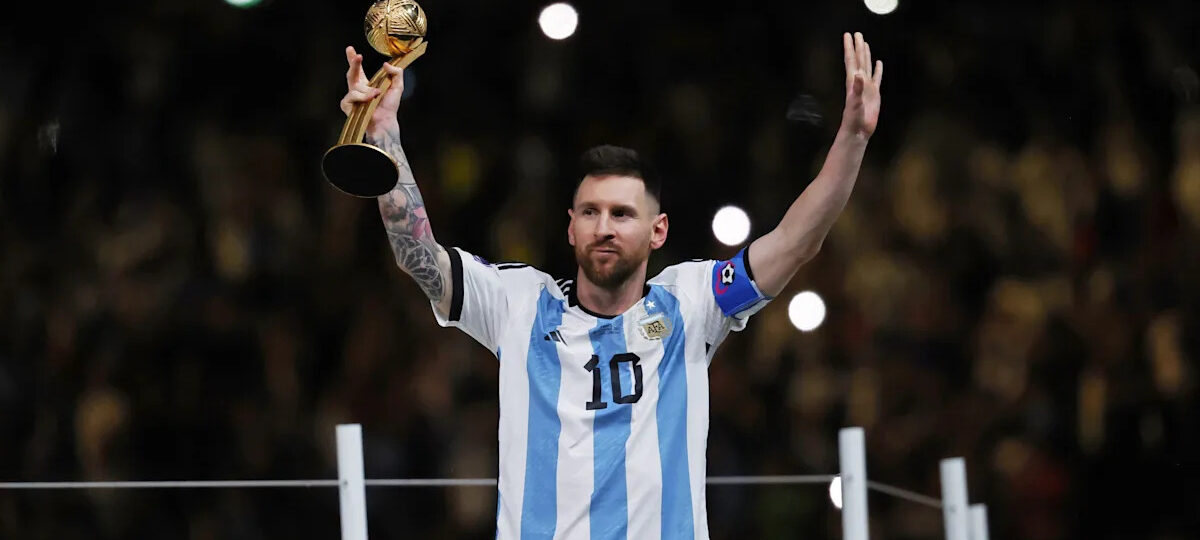
Longevity records might be the most vulnerable in a tournament that now offers up to eight matches for teams reaching the final. The all-time leaders in World Cup appearances have benefited from deep runs, and Lionel Messi set a benchmark with 26 World Cup matches by the end of Qatar 2022. Of course, Messi is back for a record sixth World Cup. He will help Argentina defend its 2022 title, so as soon as he plays in one match, the record will fall.
Veteran stars who debuted in 2014 or 2018 and are still going strong in 2026 could stack another six or seven caps onto already hefty totals.
Fastest goal in World Cup history
From carefully choreographed kick-off routines to high-press traps, modern coaches spend real time scripting the first minute of matches. That trend alone makes the record for fastest World Cup goal ripe for a challenge. The current mark is held by Hakan Şükür, who scored for Turkey after just 11 seconds against South Korea in 2002.
One miscontrolled back pass or a rehearsed long-ball pattern could spring a forward through on net in the opening seconds. Teams that press high from the whistle could also capitalize on nerves from underdog opponents in massive stadiums.
Highest average attendance for a World Cup
From massive NFL venues in the United States to large stadiums in Mexico and Canada, the infrastructure for 2026 is built around big crowds. The existing record for average attendance per match dates back to USA 1994, when crowds averaged 68,991 per game.
Modern stadiums in Dallas, Los Angeles, New York and elsewhere hold 70,000-plus for soccer. Even with some group-stage fixtures outside traditional soccer hotbeds, the overall average has a clear path to climbing.
Longest unbeaten run at the World Cup
Stretching an unbeaten run across multiple tournaments has always been tricky, but the expanded format gives an in-prime powerhouse the chance to compile a streak that looks almost impossible on paper. Nations that went deep in 2018 and 2022 can carry those results into 2026 with momentum and continuity.
Argentina enters the 2026 World Cup with a six-match unbeaten streak. So Messi’s side could approach the all-time mark held by Brazil (13, 1958-66) with an unbeaten run.
Discover more from NAIRAVOICE.COM.NG
Subscribe to get the latest posts sent to your email.