The brilliance of science fiction lies in its ability to blend thrilling, out-of-this-world spectacle with explorations of human fears, ethics, and big ideas rooted in science. Through wonder and escapism, these films transport us to strange new worlds, futuristic cities, or deep space, giving our brains a moment of reprieve. Whether robots, clones, aliens, or artificial intelligence, these stories often mirror our mortality, isolation, and capacity to be human.
A good flick will sustain and entertain, but a brilliant sci-fi film will hook you immediately. Though incredible sci-fi movies exist throughout cinema history, these seven hook you within the first ten minutes. From a thrilling chase to a scrolling exposition that establishes an entire galaxy, these movies capture you instantaneously, leaving an impression that lasts far beyond the final credits.
‘Blade Runner’ (1982)
<<img src="https://static0.colliderimages.com/wordpress/wp-content/uploads/2026/06/blade-runner-harrison-ford-1.jpg?q=49&fit=crop&w=825&dpr=2" />
Image via Warner Bros.</figure>
Based on Philip K. Dick‘s 1968 novel, Blade Runner is a cyberpunk neo-noir science fiction thriller set in a dystopian Los Angeles in 2019. Retired police officer Rick Deckard (Harrison Ford) is forced back into service as a blade runner to “retire” bioengineered synthetic humans known as replicants. The film uses its narrative to question the boundary between human and machine.
Through visual overload, the film opens on a sweeping industrial city landscape, seemingly foreign to our modern eye, where fire-belching smokestacks, flying cars, and neon lights dominate the skyline. The camera then cuts to an extreme close-up of a human eye reflecting the cityscape, establishing the core themes of vision, surveillance, and the blurred line between what’s natural and what is manufactured. From there, the audience is plunged into Dave Holden’s (Morgan Paull) high-stakes Voight-Kampff interrogation of Leon (Brion James), a Nexus-6 replicant. With the world established, our hero, Deckard, is introduced, sitting on a rainy, grimy street as his mission is about to begin.
‘Children of Men’ (2006)
<<img src="https://static0.colliderimages.com/wordpress/wp-content/uploads/2026/02/children-of-men-2006.jpg?q=49&fit=crop&w=825&dpr=2" />
Image via Universal Pictures</figure>
In Alfonso Cuarón‘s dystopian action thriller Children of Men, the planet is experiencing global infertility as humans have mysteriously lost the ability to procreate. As civilization crumbles, plagued by suicide, despair, and terrorism, the United Kingdom stands as one of the last functioning governments, turning into an authoritarian regime that rounds up, detains, and deports “fugees.” Theo Farron (Clive Owen) is tasked with transporting Kee (Clare-Hope Ashitey), a miraculously pregnant refugee, to the Human Project.
The film’s opening scene masterfully hooks you through abrupt worldbuilding, sensory shock, and a complete subversion of the genre. In total darkness, a bleak news broadcast drops key information about the dystopian stakes. When the visuals kick in, the camera tracks Theo as he pushes through a grieving crowd watching the news. The action kicks in when the coffee shop he just left explodes violently. The audio drops, mirroring the ringing tinnitus and capturing our protagonist’s temporary deafness as a striking image of a bleeding woman holding her severed arm is seen. The sudden, visceral violence shatters all sense of safety as Cuarón’s continuous, unbroken shot forces you to experience the event in real time.
‘Edge of Tomorrow’ (2014)
<<img src="https://static0.colliderimages.com/wordpress/wp-content/uploads/2022/06/Edge-of-Tomorrow-Tom-Cruise.jpg?q=49&fit=crop&w=825&dpr=2" />
Image via Warner Bros.</figure>
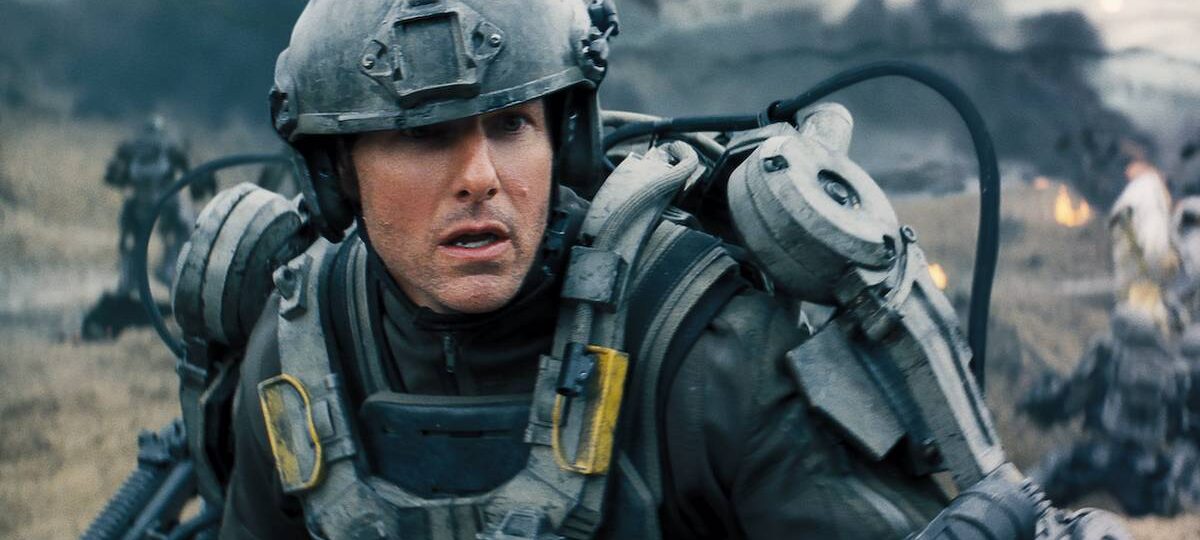
In Doug Liman‘s military sci-fi action film Edge of Tomorrow, Major William Cage (Tom Cruise), a military public relations officer with no combat experience, is thrust into a time loop during a desperate human war against an alien race known as mimics. As the war rages on, Cage wakes up the next morning before the battle, only to find the loop resets to the same day every time he dies. He teams up with Rita Vrataski (Emily Blunt) as they train, die, and investigate the mysterious alien hivemind.
Within the first ten minutes, the film becomes a masterclass in efficient, high-stakes storytelling. Through an aggressive montage of real-world and fictional news footage, you’re caught up on years of lore before meeting Cage, a smarmy PR slickster who desperately avoids the battlefield. The tension spikes when he is unexpectedly dropped on the front lines of a suicide mission beach invasion. Liman captures claustrophobic dread as Cage, strapped into a massive, lethal, weaponized suit, has no idea how to maneuver. Edge of Tomorrow establishes a terrifying world where death seems imminent.
‘Star Wars: Episode IV—A New Hope’ (1977)
<<img src="https://static0.colliderimages.com/wordpress/wp-content/uploads/2026/02/star-wars-1977.jpg?q=49&fit=crop&w=825&dpr=2" />
Image via 20th Century Studios</figure>
All it took was a scroll to change the galaxy. In Star Wars: Episode IV—A New Hope, the first film in George Lucas‘ long-running franchise, a classic hero’s journey unfolds during a galactic civil war against the tyrannical Galactic Empire. The Rebel Alliance steals the architectural plans for the planet-destroying superweapon, the Death Star. Luke Skywalker (Mark Hamill) joins Obi-Wan Kenobi (Alec Guinness) and hired smuggler Han Solo (Harrison Ford) to rescue Princess Leia (Carrie Fisher) from Darth Vader’s (James Earl Jones) clutches.
Star Wars hooks you immediately with John Williams‘ fanfare and the epic yellow text crawl that sets up the entire story. Without lecturing or boring the audience, the rolling text throws you into the fray at warp speed. From there, an endless Imperial Star Destroyer roars overhead as C-3PO and R2-D2 bicker through the chaos, giving you characters to latch onto instantly. As the smoke clears, the greatest sci-fi villain emerges, and terror is born without a lengthy introductory monologue. The iconic opening became a franchise staple, exciting fans for generations.
The scores below reveal how the Force sees you. Your highest number is your true alignment. Read on to understand what that means — and what it will cost you.
Disciplined, compassionate, and deeply attuned to the living Force, you have walked the path long enough to understand its demands — and accept them. You lead not through authority alone, but through example. You have felt the pull of the dark side and chosen otherwise, every time. That is not certainty. That is courage.
You are earnest, powerful, and brimming with potential — and you know it, which is both your greatest asset and your most dangerous flaw. You act before you think, trust your gut over your training, and sometimes confuse impatience for bravery. The Masters see something in you, though. The question isn’t whether you have what it takes — it’s whether you’ll be patient enough to find out.
You are not simply dangerous — you are certain, and that is worse. You have decided what the galaxy needs, and you have decided you are the one to deliver it. Your power is genuine and formidable, earned through sacrifice that would have broken lesser beings. But examine your victories carefully. Every Sith believed their cause was righteous. The dark side’s cruelest trick is that it agrees with you.
You were forged in fire and reshaped by those who found you at your lowest. You serve, because service gave you structure when you had none. Your allegiance is not to an ideology — it is to survival and to the master who gave you purpose. But there is something buried beneath the conditioning. The Jedi you hunt? You recognize them. Because you remember what it felt like before the choice was taken from you.
You have looked at the Jedi Code and the Sith Code and found both of them incomplete. You walk the line not out of indecision but out of conviction — you genuinely believe both extremes miss something essential. The Jedi don’t fully trust you. The Sith think you’re wasting your potential. They’re both partially right. But so are you.
‘The Matrix’ (1999)
<<img src="https://static0.colliderimages.com/wordpress/wp-content/uploads/2026/04/the-matrix-1999-keanu-reeves-1.jpeg?q=49&fit=crop&w=825&dpr=2" />
Image via Warner Bros. Pictures</figure>
Written and directed by the Wachowskis, The Matrix follows computer hacker Neo (Keanu Reeves), who discovers that human reality is a complex computer simulation known as The Matrix. Rebel leader Morpheus (Laurence Fishburne) and his partner Trinity (Carrie-Anne Moss) contact him and see him as “The One” with the power to bend and manipulate the Matrix’s physical laws and fightthe computer programs that police the simulation.
A high-octane philosophical wonder, The Matrix establishes mystery and breaks the laws of physics as it introduces an immediate, high-stakes threat. The film opens with glowing green computer code shifting across a black screen, establishing the cyberpunk atmosphere, with the only explanation being the voice of a woman discussing the mysterious “Neo.” Espionage and curiosity arrive as Trinity is cornered by a police squad, and bang! The infamous bullet time is revealed. The groundbreaking effect comes as a cinematic, mind-bending shock.
‘The Terminator’ (1984)
<<img src="https://static0.colliderimages.com/wordpress/wp-content/uploads/2022/01/terminator-1984-arnold-schwarzenegger.jpg?q=70&fit=crop&w=825&dpr=1" />
Image via Orion Pictures</figure>
A brilliant product of its time, James Cameron‘s The Terminator set the tone for sci-fi action films in the decades that followed. The first film in the franchise follows a T-8000 cyborg assassin (Arnold Schwarzenegger) sent back in time from a post-apocalyptic 2029 to 1984 Los Angeles to kill Sarah Connor (Linda Hamilton). The human resistance fights back as lone soldier Kyle Reese (Michael Biehn) is sent to protect her.
Within the opening minutes, Cameron grabs your attention with a bleak, post-apocalyptic Los Angeles that shows giant machines crushing human skulls. When the story transitions to 1984, a different type of fear is introduced when two completely naked men emerge from a violent, crackling electrical storm. Both search for clothes in different ways: The Terminator’s innate brutality arrives as an unstoppable, silent force of nature, killing a group of punks, including ripping through one’s torso. Meanwhile, Reese is set up as the desperate underdog, without that same strength.
‘WALL-E’ (2008)
<<img src="https://static0.colliderimages.com/wordpress/wp-content/uploads/2024/09/wall-e-2008-poster.jpg?q=49&fit=crop&w=825&dpr=2" />
Image via Pixar Animation Studios</figure>
A truly delightful sci-fi story, WALL-E helped young viewers fall in love with the genre like never before. The story follows WALL-E, a lonely trash-compacting robot on a ruined, abandoned Earth who follows a sleek probe droid named EVE across the galaxy to help humanity rediscover its home. A beautifully filmed, philosophically tinged wonder, WALL-E remains one of Pixar’s best.
Within the first 10 minutes, the film uses pure visual and auditory storytelling to build instant empathy for a rusty old robot on a ruined planet, without a single word of dialogue. The wasteland is strikingly juxtaposed with the upbeat, toe-tapping vintage sounds of “Put On Your Sunday Clothes” from Hello, Dolly! As the titular character is introduced, WALL-E becomes instantly endearing as he embarks on his daily routines, hoarding treasures and artifacts like a lighter, a Rubik’s Cube, and the film’s VHS. His childlike curiosity mirrors our own, letting our wonder join him on his extraordinary journey.
Discover more from NAIRAVOICE.COM.NG
Subscribe to get the latest posts sent to your email.