

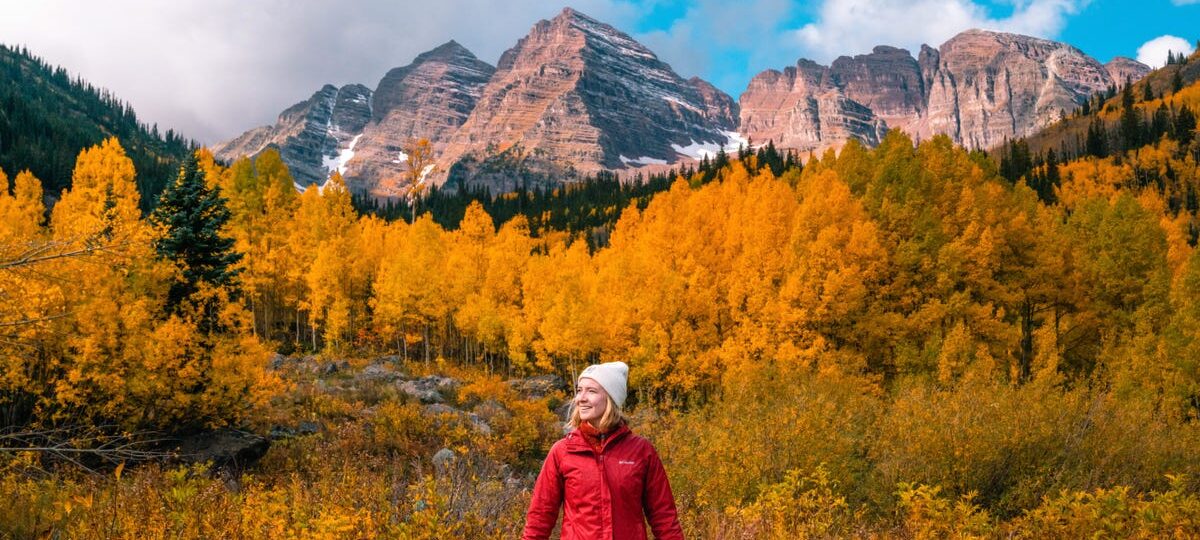
With crisp mornings already creeping in across some states, fall is on its way.
Visiting national parks to see the season’s colors, or “leaf peeping,” is a popular pastime and gives a major boost to some states’ economies.
An analysis by Appalachian State University estimated that fall-foliage tourism contributes more than $30 billion annually to local economies across 24 eastern states.
Alexandra Blodgett understands the appeal.
The travel content creator spoke to Business Insider in 2024 about her favorite national parks — at that time, she had been to 35, as well as every state in the US.
While she’s enjoyed a myriad of experiences, from hiking scenic trails to basking in stunning views from cliff tops, she said her favorite, by far, is watching national parks undergo their annual autumnal transformation. “I’m pretty focused on outdoor natural beauty,” Blodgett, who has spent years traveling in an RV with her husband, told Business Insider.
If you plan on hitting the road to catch the fall foliage — usually visible from late September in northern states before moving south throughout October and into November — Blodgett has a few under-the-radar and chilled-out spots to recommend.
Here are her five favorite national parks to visit in the fall.
Blodgett said not enough people talk about this 505,000-acre park, which is a three-hour scenic drive from Seattle.
And yet, its larch-lined valleys and pristine glacial lakes make it a must-visit spot. “I think that’s a very underrated national park,” Blodgett said. “The reason is that many of the most beautiful places are deep in the backcountry.” “Because of that, it’s a really great place for hikers, and it’s still a beautiful park for anyone to visit because there are a ton of beautiful things that you don’t necessarily have to hike super deep to get to,” she added.
What stands out are the towering larch trees, bursting in shades of gold, including around nearby Maple Pass and Blue Lake.
There’s also the Diablo Lake Overlook, which gives views of Diablo Lake with jagged peaks known as the American Alps as a backdrop.
Peak fall period: Leaves along the byway leading to the park begin changing color in late September, with some spots peaking by mid-October, although fall conditions can change year to year.
Tree types: There are yellow aspen, multi-colored mountain ash, golden larches, cottonwoods, and vine maples, among others.
Picture this: 21 square miles of pristine blue water set against the backdrop of Cascade cliffs and some of the cleanest air in the country.
America’s deepest lake is a sight for all seasons, but especially worthy of a visit in the fall.
Blodgett recommends spending at least two full days. “There’s one drive throughout the park, Rim drive, that would definitely take up a whole day or more depending on how much time you want to spend on it, and then another day to explore some of the other little ad hoc areas like the Rim village and the Pinnacles,” she said.
That said, visitors should check current conditions before setting out for the journey — construction has closed the Cleetwood Cove Trail and some sections of East Rim Drive this year.
While the park is typically well-trafficked throughout the year, Blodgett said it’s another “unique” and “super beautiful” place that doesn’t get as much attention.
Plus, she added, it’s just as, if not more, beautiful in the wintertime. “They get so much snow that it’s mind-blowing to see that much snow in one spot,” she said. “I love that about Crater Lake.” Peak fall period: In Oregon, trees are bursting with color in mid-October, but leaves start to turn golden in the first few weeks of September.
Tree types: While most of the trees in the park are coniferous, quaking aspen, black cottonwood, willows, alders, and dogwoods add bursts of color.
This national park is home to epic sights, including yellow leaves set against the backdrop of red-rock canyons.
Blodgett said Capitol Reef is a popular road-trip stop because it’s one of “the big five,” or the five national parks in Utah: Arches, Bryce Canyon, Canyonlands, Capitol Reef, and Zion.
Despite its popularity, Blodgett said there are plenty of underrated things to see and experience there, “and most people just kind of scratch the surface just to tick it off their list.” Instead, she highly recommends you “make sure you have enough time to explore a little bit more in-depth.” Nearby Byway 12 has some fantastic stops for a full view of the fall shades.
If you prefer to explore by foot, you can hike along the Hickman Bridge or Capitol Gorge Wash, and if you’re traveling with kids, fruit picking at the orchards is great to add to your list.
Peak fall period: Trees at an elevation of 8,000 to 10,000 feet reach peak fall colors in early October, slowly spreading downwards by mid-October, with the lowest elevations peaking end of October to early November.
Tree types: Aspen trees, cottonwoods, and box elder trees, and some fruit orchards can be seen throughout the park.
Although getting to this western North Dakota park requires some determination, it’s worth a trip in the fall, especially if you also love wildlife spotting. “The free-roaming feral horses in the park are really unique, and a lot of people don’t know that they’re there.
So that’s kind of fun,” said Blodgett.
In addition to the horses, visitors might catch a glimpse of bison, elk, white-tailed and mule deer, other mammals, amphibians, and reptiles.
The best way to experience the park’s fall colors is to drive along the 28-mile round-trip scenic drive in the North Unit, or you could hike to the top following the Boicourt Overlook Trail in the South Unit.
Peak fall period: Leaves change in mid-September and typically peak at the end of the month.
Tree types: The park predominantly features cottonwoods.
This isn’t your typical fall foliage experience, given that most of the badlands are primarily home to grasslands.
Still, the towering red-and-tan rock formations more than make up for the lack of forest views.
Blodgett told BI she thinks Badlands National Park is another “beautiful yet underrated park.” She recommends spending two days at the park, which will give you ample time to spot some wildlife and stargaze at night.
Peak fall period: Grasslands begin changing color from green to golden yellow at the end of summer, in early September, and remain colorful until October.
Tree types: A large part of the park is covered in knee-high prairie grass but is also home to over 400 other plant varieties.
Editor’s note: A version of this story was originally published in October 2024.
Discover more from NAIRAVOICE.COM.NG
Subscribe to get the latest posts sent to your email.