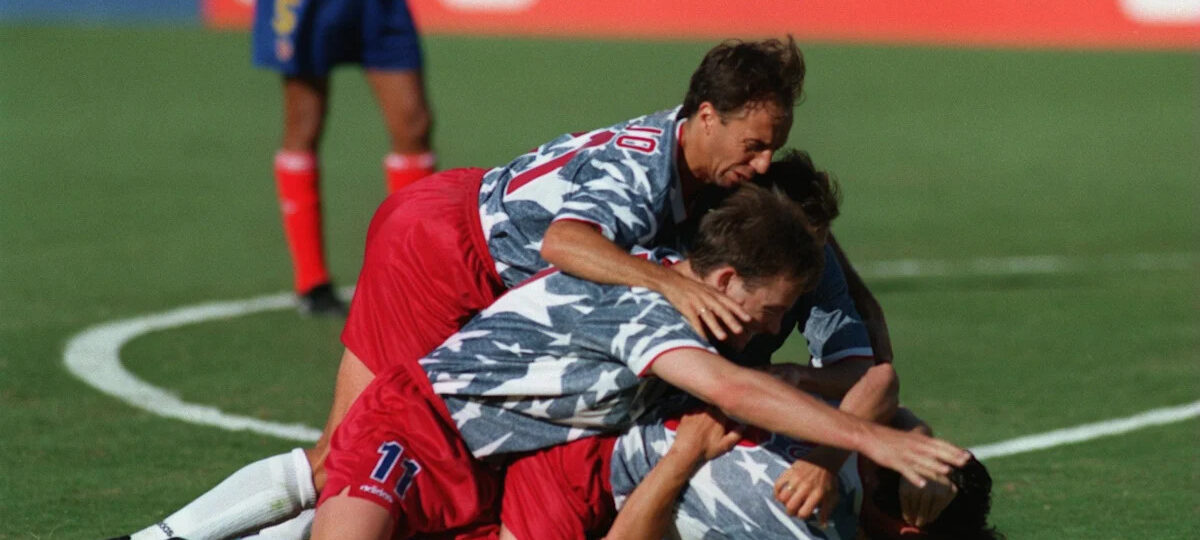
CHICAGO — The U.S. men’s national team knew it wasn’t going to win the 1994 World Cup.
They couldn’t contend with the powers from Europe or South America, where there were professional leagues and a century’s worth of tradition. It wasn’t the goal, though. The goal was to lay a foundation, create a base upon which soccer in the United States could grow to the point where the USMNT would contend with the best in the world.
“We could have either made soccer or broke soccer,” Marcelo Balboa, a defender on the ’94 squad, said June 6, when members of the team were recognized before the current USMNT’s last game before the World Cup.
“Somebody said it the other day, `We could have (screwed) up soccer if we don’t get out of the group,'” Balboa said. “If we got blown out in those three games, who would have known what happened with soccer?”

There have always been pockets of the United States where soccer was big. Communities with large immigrant populations, mostly. But even when the USMNT had success at the World Cup – reaching the semis in the inaugural tournament in 1930, stunning England in 1950, ending a 40-year absence in 1990 – it didn’t create a groundswell of interest. Baseball, basketball and football were just too big.
It’s not that kids didn’t play it. Beginning in the 1970s, soccer took hold as a “beginner” sport for U.S. school kids. Drive by any park or schoolyard on the weekends, and you’d see scores of grade schoolers playing.
But even for those kids who stuck with it, soccer was a dead end. There was no professional outdoor league in the United States, and the number of Americans who drew the interest of overseas clubs was minimal.
The 1994 tournament changed all that. Knowing the USMNT couldn’t afford a mediocre performance, let alone an embarrassing one, U.S. Soccer created a residency for those players who weren’t playing professionally.
Which was most of them. For more than a year, about 40 players lived and trained together in Southern California.
“There was a lot of pressure,” said Cobi Jones, who made the first of three World Cup teams in 1994.
“We understood that there was an opportunity to help build this sport, and you didn’t want to stumble or flounder when all this attention was going to be on the sport, was going to be on the team,” Jones said. “You didn’t want to mess up. You didn’t want to screw it up.”
To be successful, to generate a buzz, to win Americans over to the sport they loved, the USMNT knew they had to get out of their group.
This was hardly a given. Colombia and Romania had both reached the Round of 16 in 1990, and Colombia had Carlos Valderrama. An aging Valderrama, but Carlos Valderrama, nonetheless.
The USMNT opened the World Cup with a draw against Switzerland. In the second game, though, they stunned Colombia. Andres Escobar’s own goal would have been enough, but Earnie Stewart added an insurance goal.
The USMNT lost to Romania in the group-stage finale, but advanced to the knockout rounds as one of the best third-place teams.
“We bled, we fought, we scratched, we found ways to get out of that group, which surprised everybody, through Columbia,” Balboa said.
Brazil beat the Americans in the Round of 16 on its way to winning its fourth World Cup title. But the enthusiasm the upstart USMNT had generated forever changed the game in the United States.
“All we wanted to do was set up a foundation for soccer,” Balboa said. “We knew we weren’t going to be around for a long time, but if we could lay a foundation in ’94 — to what the standard was, what we thought it would be and that’s getting out of the group, then every other generation could build on it.”
1930– Uruguay defeats Argentina 4-2 in the first World Cup event held in Uruguay.
 1 / 21
1930– Uruguay defeats Argentina 4-2 in the first World Cup event held in Uruguay.
 2 / 21
1934– Italy over Czechoslovakia 2-1.
 3 / 21
1938– Italy defeats Hungary 4-2. The World Cup would not be played again until 1950 because of the Second World War.
 4 / 21
1950– Uruguay wins it’s second World Cup with a 2-1 win over Brazil.
 5 / 21
1954– Germany wins 3-2 over Hungary.
 6 / 21
1958– Brazil celebrates by running with the flag of Sweden after defeating them 5-2.
 7 / 21
1962– Brazil 3-1 over Czechoslovakia.
 8 / 21
1966– England defeats Germany 4-2 in England.
 9 / 21
1970– Brazil wins 4-1 over Italy in Mexico.
 10 / 21
1974– Germany wins at home in Munich over Netherlands, 2-1.
 11 / 21
1978– Argentina wins it’s first World Cup 3-1 over Netherlands in Argentina.
 12 / 21
1982– Italy wins it’s third championship over Germany 3-1.
 13 / 21
1986– Argentina wins over Germany 3-2.
 14 / 21
1990– Germany gets revenge on Argentina 1-0.
 15 / 21
1994– Brazil defeats Italy 3-2 in penalties in Pasadena, Calif.
 16 / 21
1998– France wins it’s first cup over Brazil, 3-0.
 17 / 21
 18 / 21
2006– Italy beats France 5-3 in penalties.
 19 / 21
2010– Spain defeats Netherlands 1-0 in South Africa.
 20 / 21
 21 / 21
2022– Argentina wins it’s third World Cup defeating France 4-2 in penalties.
Major League Soccer began play two years later, while the number of Americans in Europe slowly grew. The World Cup returned to the United States for the women’s tournament in 1999, and fans gave the U.S. women’s national team rock-star treatment.
By 2002, the USMNT had players — Landon Donovan, Brian McBride, Claudio Reyna — who any European team would gladly have taken, and they reached the World Cup quarterfinals. By 2018, the expectations had grown to the point that failing to qualify for the World Cup in Russia was considered a national embarrassment.
Now, in 2026, the USMNT has a “golden generation” with Christian Pulisic, Tyler Adams, Weston McKennie and Tim Weah.
“Soccer in the United States has grown amazingly,” Stewart said. “You see where it is today … all these soccer specific stadiums, you have all these players playing overseas in really good leagues. So that says a lot.”
How the U.S. team fares at this World Cup will no longer make or break soccer in this country. But it will determine whether there’s another explosion in growth as there was after 1994 or the game continues on its steady rise.
“I really think our guys are ready,” Eric Wynalda said, “and are going to give us one hell of a ride.”
The U.S. men’s national team World Cup roster is out, for real this time. Three days after the team’s squad was fully leaked, USMNT head coach Mauricio Pochettino officially revealed his 26-man roster for the 2026 tournament on Tuesday, May 26. The release confirmed the leak was, in fact, accurate, as the 26 names matched the 26 The Guardian first reported over the weekend. The names didn’t feature too many surprises, though there were still one or two decisions that could be characterized as head-scratching. “We are confident this is the best group of 26 players to help us achieve success at the World Cup,” Pochettino said. See who made the team:
Christian Pulisic, attacking midfielder/winger
 1 / 26
The U.S. men’s national team World Cup roster is out, for real this time. Three days after the team’s squad was fully leaked, USMNT head coach Mauricio Pochettino officially revealed his 26-man roster for the 2026 tournament on Tuesday, May 26. The release confirmed the leak was, in fact, accurate, as the 26 names matched the 26 The Guardian first reported over the weekend. The names didn’t feature too many surprises, though there were still one or two decisions that could be characterized as head-scratching. “We are confident this is the best group of 26 players to help us achieve success at the World Cup,” Pochettino said. See who made the team:
Christian Pulisic, attacking midfielder/winger
 2 / 26
 3 / 26
 4 / 26
 5 / 26
 6 / 26
 7 / 26
 8 / 26
 9 / 26
 10 / 26
 11 / 26
 12 / 26
 13 / 26
 14 / 26
 15 / 26
 16 / 26
 17 / 26
 18 / 26
 19 / 26
 20 / 26
 21 / 26
 22 / 26
 23 / 26
 24 / 26
 25 / 26
 26 / 26
Discover more from NAIRAVOICE.COM.NG
Subscribe to get the latest posts sent to your email.